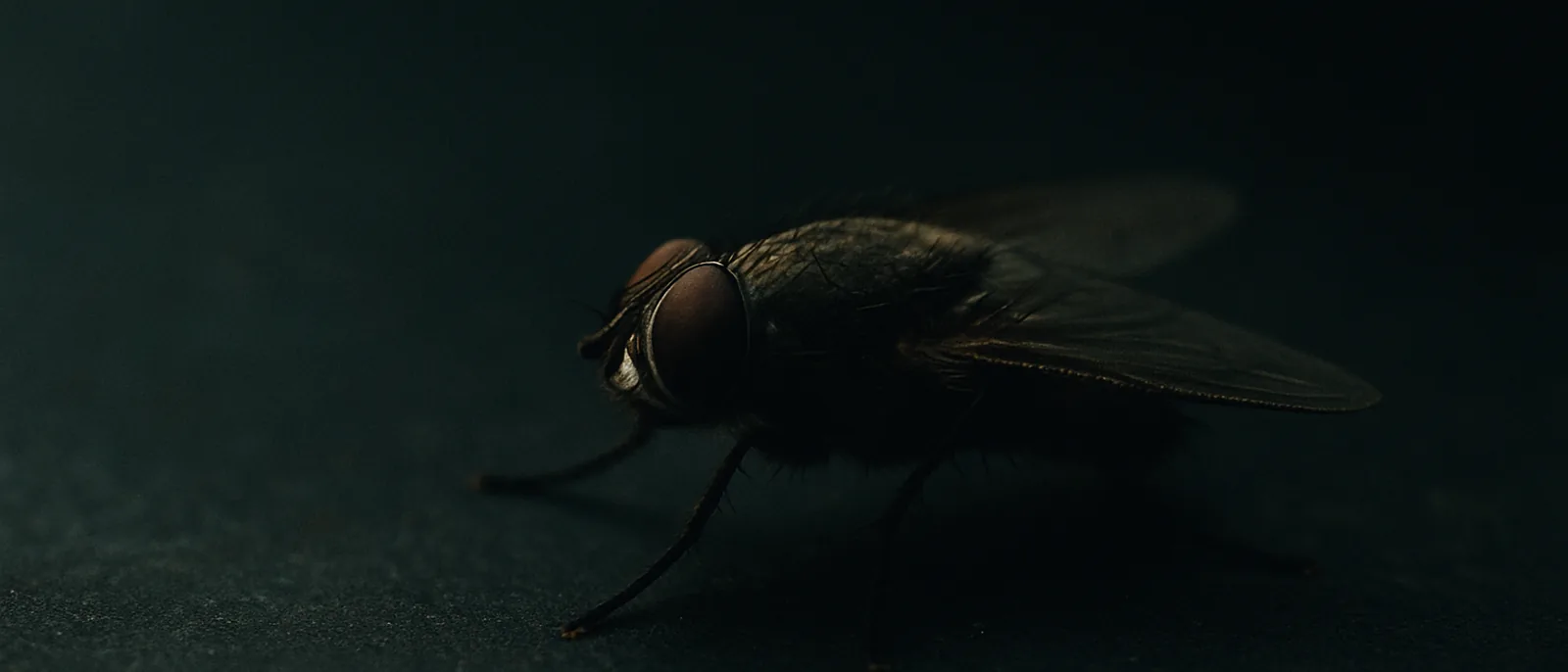
This entry examines the fly parable in Surah al-Hajj 22:73 and a modern gloss on its second clause. The passage is explicitly a parable about the impotence of false gods, and the scientific reading here is weak.
The source text
يَـٰٓأَيُّهَا ٱلنَّاسُ ضُرِبَ مَثَلٌ فَٱسْتَمِعُوا۟ لَهُۥٓ ۚ إِنَّ ٱلَّذِينَ تَدْعُونَ مِن دُونِ ٱللَّهِ لَن يَخْلُقُوا۟ ذُبَابًا وَلَوِ ٱجْتَمَعُوا۟ لَهُۥ ۖ وَإِن يَسْلُبْهُمُ ٱلذُّبَابُ شَيْـًٔا لَّا يَسْتَنقِذُوهُ مِنْهُ ۚ ضَعُفَ ٱلطَّالِبُ وَٱلْمَطْلُوبُ
“O people, an example is presented, so listen to it. Indeed, those you invoke besides Allāh will never create [as much as] a fly, even if they gathered together for it [i.e., that purpose]. And if the fly should steal away from them a [tiny] thing, they could not recover it from him. Weak are the pursuer and pursued.”
Qur'an 22:73 · Saheeh International
What was understood in the seventh century
In seventh-century Arabia the fly was regarded as a trivial, contemptible insect, and the parable's rhetorical force rests on that lowliness. The verse presses two points: that anything worshipped besides God could never create even a fly, however many gathered for the task, and that if a fly snatches something away, those false gods could not recover it. There was no knowledge of what a fly's body might chemically do to a substance it takes.
The verse names itself a mathal (parable) and opens by addressing "O people," framing the whole passage as an argument about worship rather than a description of insect biology. The closing line, "weak are the pursuer and the pursued," reinforces that the subject is impotence, not entomology.
The modern correspondence
The primary point of the verse is theological, on the powerlessness of anything invoked besides God. A minority of modern commentators have connected the second clause, that what the fly snatches cannot be recovered, to the observation that flies rapidly break down and contaminate matter they contact, through digestive enzymes and microbial load, so that a substance a fly seizes is chemically altered and cannot be retrieved intact.
This is a modern gloss layered onto a parable, developed only after microbiology made the fly's contaminating action understandable, and it is not the mainstream classical reading of the clause. The verse's manifest sense concerns the feebleness of false gods, and the enzymatic interpretation is a secondary, and strained, extension.
Considerations and counterpoints
Skeptics stress that the passage is explicitly a parable about the weakness of false gods, and that "they could not recover it from him" most naturally means the worshippers are too feeble to take back even a trifle, not a claim about enzymes. Reading digestive chemistry into it is anachronistic and unsupported by classical tafsir, which treated the fly simply as a byword for the negligible. Defenders of the gloss concede that it is secondary and offer it only as a possible added layer rather than the plain meaning, which is itself a fair acknowledgement of its weakness. The scientific reading rests on an interpretation that most commentators do not treat as the verse's meaning, and it should be presented as such rather than as an established sign.
Credibility rating: Tier 3 · Contested — The verse is a rhetorical parable about idolatry; the 'irrecoverable snatch' scientific reading is a strained, secondary interpretation that most commentators do not treat as its meaning.