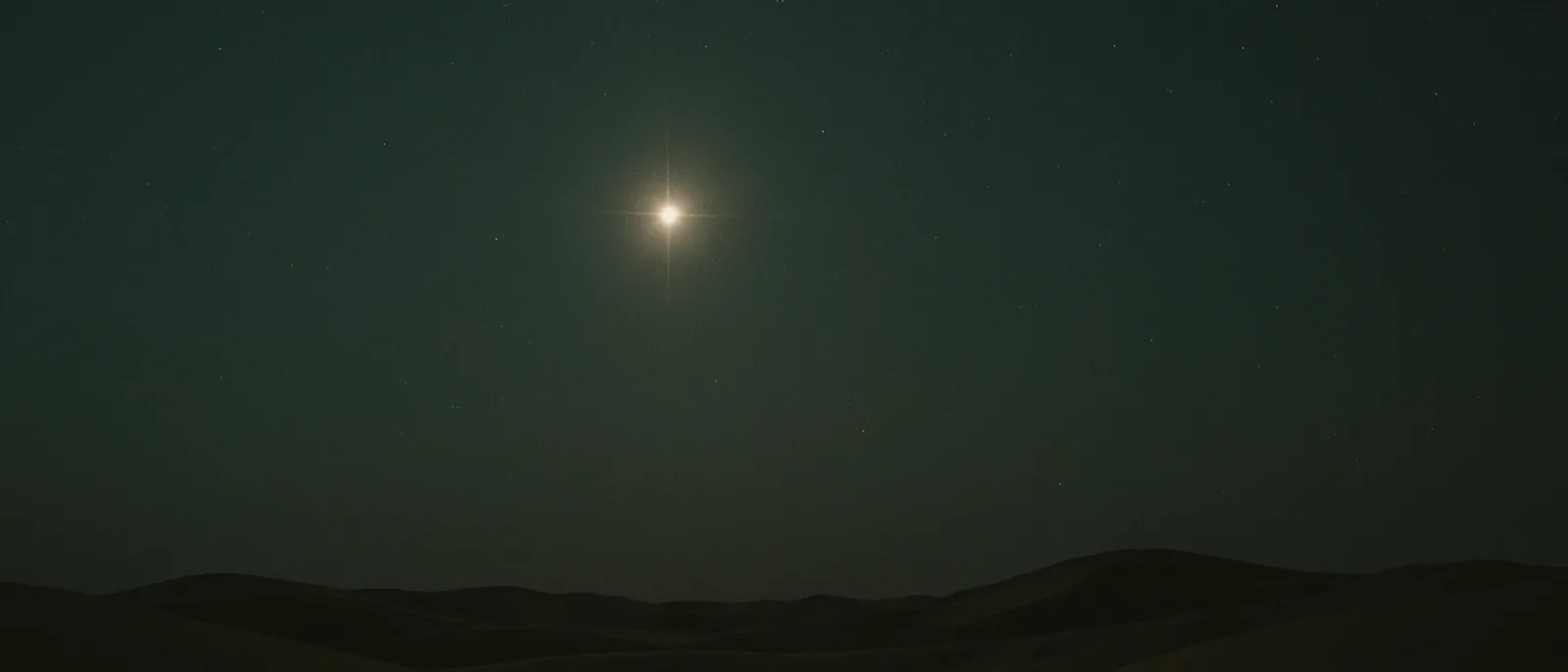
This entry examines Surah an-Najm 53:49, which names God “the Lord of Sirius,” the brightest star in the night sky. The verse's force is historical and theological rather than scientific, and the popular numerical extensions attached to it are unsound; the entry is included because it is so commonly cited.
The source text
وَأَنَّهُۥ هُوَ رَبُّ ٱلشِّعْرَىٰ
“And that it is He who is the Lord of Sirius”
Qur'an 53:49 · Saheeh International
What was understood in the seventh century
Sirius — ash-Shi'ra in Arabic — was well known to pre-Islamic Arabs. Classical sources report that some tribes, notably Khuza'ah, worshipped it, and its heliacal rising marked seasonal reckoning across the ancient world. The verse names Sirius specifically to assert that God, not the star, is Lord: a direct rebuke of an existing Arabian cult, delivered in the community of the Prophet Muhammad (peace be upon him). Nothing about the star's physical nature was known beyond its brightness and position. Surah an-Najm — “The Star” — situates the verse in a passage recounting what God has done and undone, addressed to a Meccan audience for whom ash-Shi'ra was a familiar name and, for some, an object of devotion.
The modern correspondence
Modern astronomy identifies Sirius as an A-type main-sequence star 8.6 light-years away, roughly 25 times more luminous than the sun, with a white-dwarf companion: Friedrich Bessel inferred the companion from orbital wobble in 1844, and Alvan Graham Clark first observed Sirius B in 1862; the pair orbit each other with a period of about 50 years, as described in the Britannica entry on Sirius. Bessel's inference — a star pulled from its expected path by an unseen companion — was itself a landmark of nineteenth-century positional astronomy.
The historically solid point is modest: the Qur'an singles out for demotion the one star its contemporaries were worshipping. Some popular literature goes much further, linking the verse number 49 or letter counts to Sirius B's orbital period; such numerological claims have no scholarly standing and are noted here only so that readers recognize them.
Considerations and counterpoints
Skeptics note that the verse makes a theological claim — God is Sirius's Lord — not an astronomical one, and that naming a famous, locally worshipped star requires no special knowledge. The orbital-period numerology depends on arbitrary counting conventions, ignores that the period is not exactly 49 years, and could be replicated for many star-number pairs by chance. Even sympathetic Muslim scholars generally exclude this item from serious i'jaz lists. The honest framing, adopted here, is historical-polemical interest rather than scientific foreknowledge: the verse tells us something real about seventh-century Arabia, not about binary star systems.
Credibility rating: Tier 3 · Contested — The verse is authentic and historically pointed, but as a science-miracle claim it asserts nothing about Sirius that was unknown, and the popular numerological extensions are unsound.