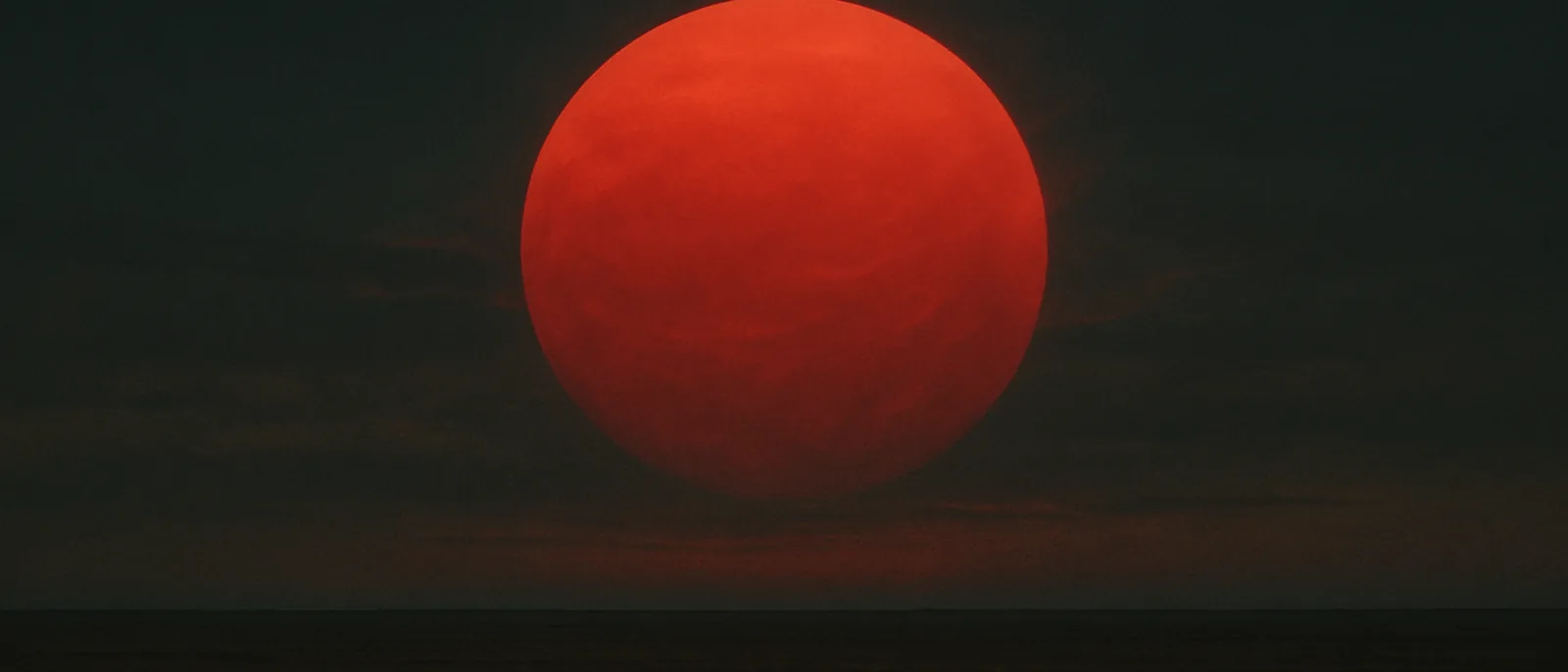
This entry considers the opening verse of Surah at-Takwir, in which the sun is 'wrapped up' at the end of the world, and the modern reading that connects it to the eventual death of the sun. The parallel captures a real astronomical fact but not its specifics, and the entry is graded accordingly.
The source text
إِذَا ٱلشَّمْسُ كُوِّرَتْ
“When the sun is wrapped up [in darkness]”
Qur'an 81:1 · Saheeh International
What was understood in the seventh century
Surah at-Takwir opens with a rapid series of cataclysmic images marking the Day of Judgment: the sun wound up, the stars falling, the mountains set moving, the seas made to boil. The first of these uses the verb kuwwirat, from a root meaning to coil or wrap — the motion of winding a turban or rolling something up — applied to the sun.
To a seventh-century audience the meaning was plain: at the appointed end of the world the sun would lose its light and be folded away. The passage belongs to the Qur'an's eschatology, its account of the Last Day, and the classical commentators read it in that register, as an image of the undoing of the familiar cosmic order by the God who set it in place.
The modern correspondence
Modern astrophysics establishes that the sun is not eternal. Like every star, it burns through a finite supply of nuclear fuel. In roughly five billion years it will exhaust the hydrogen in its core, swell enormously into a red giant, shed its outer layers, and settle into a slowly cooling white dwarf — its light, in effect, extinguished.
Some commentators connect the image of the sun being 'wrapped up' and darkened to this eventual stellar death: the star that lights the sky will one day dim and go out. On this reading the verse is taken to register, in the language of its time, the fact that the sun has an end.
Considerations and counterpoints
The case here is weak, and the entry sits at Tier 3. On its plain sense the verse describes a sudden, terminal sign at the close of the world — one of a swift sequence of upheavals that classical exegetes understood as the dismantling of creation on the Last Day — not a description of stellar physics.
The scientific parallel captures only the broad idea that the sun will die. It does not match the particulars. The sun's death by red-giant expansion unfolds over billions of years, and its immediate effect on Earth would be to scorch or engulf the planet rather than simply to darken the sky. The process is gradual, not the abrupt wrapping-up the passage depicts, and the verb kuwwirat, with its sense of coiling or folding, fits the eschatological imagery more naturally than it fits stellar evolution. As with other verses of this kind, the correspondence is evocative rather than technical: the general truth that stars die can be read back into an ambiguous image, which is precisely the move that critics of the wider 'scientific miracle' genre urge readers to treat with care.
Credibility rating: Tier 3 · Contested — The verse is an eschatological sign of the Day of Judgment; the red-giant reading matches the general fact that the sun will die, but not its timescale (billions of years) or mechanism (gradual stellar evolution, not a sudden wrapping-up).