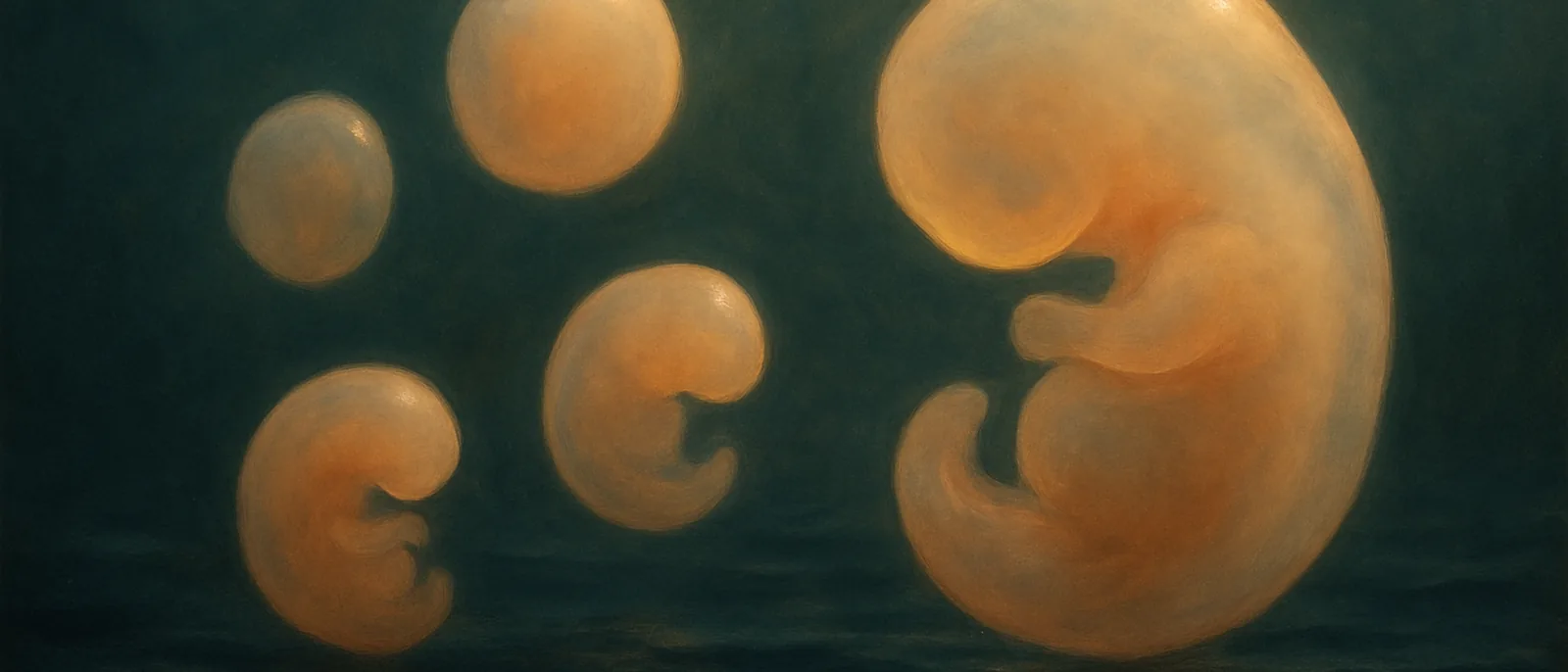
This entry examines the Qur'an's account of prenatal development in Surah al-Mu'minun 23:12-14 and al-Hajj 22:5, which names a sequence running from a drop through a clinging form and a lump of flesh to bones clothed in muscle. It asks how closely that sequence tracks the picture given by modern embryology, and where the correspondence is strong and where it is contested.
The source text
وَلَقَدْ خَلَقْنَا ٱلْإِنسَـٰنَ مِن سُلَـٰلَةٍ مِّن طِينٍ
“And certainly did We create man from an extract of clay.”
Qur'an 23:12 · Saheeh International
ثُمَّ جَعَلْنَـٰهُ نُطْفَةً فِى قَرَارٍ مَّكِينٍ
“Then We placed him as a sperm-drop in a firm lodging [i.e., the womb].”
Qur'an 23:13 · Saheeh International
ثُمَّ خَلَقْنَا ٱلنُّطْفَةَ عَلَقَةً فَخَلَقْنَا ٱلْعَلَقَةَ مُضْغَةً فَخَلَقْنَا ٱلْمُضْغَةَ عِظَـٰمًا فَكَسَوْنَا ٱلْعِظَـٰمَ لَحْمًا ثُمَّ أَنشَأْنَـٰهُ خَلْقًا ءَاخَرَ ۚ فَتَبَارَكَ ٱللَّهُ أَحْسَنُ ٱلْخَـٰلِقِينَ
“Then We made the sperm-drop into a clinging clot, and We made the clot into a lump [of flesh], and We made [from] the lump, bones, and We covered the bones with flesh; then We developed him into another creation. So blessed is Allah, the best of creators.”
Qur'an 23:14 · Saheeh International
يَـٰٓأَيُّهَا ٱلنَّاسُ إِن كُنتُمْ فِى رَيْبٍ مِّنَ ٱلْبَعْثِ فَإِنَّا خَلَقْنَـٰكُم مِّن تُرَابٍ ثُمَّ مِن نُّطْفَةٍ ثُمَّ مِنْ عَلَقَةٍ ثُمَّ مِن مُّضْغَةٍ مُّخَلَّقَةٍ وَغَيْرِ مُخَلَّقَةٍ لِّنُبَيِّنَ لَكُمْ
“O people, if you should be in doubt about the Resurrection, then [consider that] indeed, We created you from dust, then from a sperm-drop, then from a clinging clot, and then from a lump of flesh, formed and unformed - that We may show you.”
Qur'an 22:5 · Saheeh International
“The Prophet, the truthful and truly inspired, said: 'The creation of each one of you is collected in the womb of his mother for forty days in the form of a nutfah (a drop), then he becomes an alaqah (a clinging clot) for a like period, then a mudghah (a lump of flesh) for a like period, then there is sent to him the angel who blows the breath of life into him...'”
Sahih al-Bukhari 3208 · Grading: sahih (Bukhari-Muslim by definition)
What was understood in the seventh century
Seventh-century Arabia had no systematic embryology of its own. Folk belief often held that the child was preformed in miniature within the male seed, or that it was congealed menstrual blood given shape in the womb. The interior of pregnancy was hidden from ordinary observation; dissection was not practised, and the changing form of the embryo across the early weeks was not a matter anyone could inspect. There was, in short, no notion of a staged transformation carrying the conceptus from a fluid drop to bone and flesh.
Staged descriptions of prenatal growth did exist in the wider Greek medical tradition, in Hippocratic and Galenic writings that spoke of the seed, a phase associated with blood, and the gradual articulation of the parts. These were technical works in Greek, circulating among trained physicians rather than among the largely unlettered population of the Hijaz, and they differed in important respects from the Qur'anic terms. The distinctive feature of the Qur'anic passage is its compact vocabulary of successive states, each named by a single word.
A supporting narration in Sahih al-Bukhari (no. 3208), attributed to the Prophet Muhammad (peace be upon him), sets out the same terms, nutfah, alaqah and mudghah, within a forty-day framing for each phase. This gives the sequence a fixed order in the tradition and ties the exegesis of the verses to an authenticated hadith rather than to later speculation alone.
The modern correspondence
Modern embryology was formalized from the nineteenth century, as microscopy and comparative study replaced older preformationist ideas, and it is now set out in standard texts such as Keith Moore and T.V.N. Persaud's The Developing Human (Elsevier, 2019). It describes development as a sequence: a fertilized zygote, an implanting phase, an early somite phase in which the embryo has a clinging, leech-like appearance in the third to fourth week, then a somitic stage whose surface has been likened to a chewed substance, followed by the laying down of cartilage and bone and the covering of the skeleton with muscle.
Commentators have noted that the Arabic terms carry this imagery closely. Nutfah denotes a small drop of fluid; alaqah spans the senses of clinging, a leech, and a blood clot, each of which has been matched to the appearance and behaviour of the implanted embryo; mudghah means a chewed morsel, compared to the somite-marked surface of the early embryo. They also read the ordering 'bones, then We covered the bones with flesh' as matching the observed progression from the formation of the skeleton to its investment with muscle.
The correspondence argued here, then, is not a single point but a series of terms whose lexical range overlaps with distinct embryological stages, in an order that broadly follows the developmental one. The Britannica entry on prenatal development, cited in the references below, records the same broad staging that these readings invoke, and the strength of the case for supporters lies in the convergence of several terms at once.
Considerations and counterpoints
Critics, following historians such as Basim Musallam, respond that a staged embryology, seed, then a bloody or clotted phase, then a fleshy phase, then bones and flesh, was already present in the Hippocratic and Galenic medicine that had reached the Near East, so the scheme need not lie beyond seventh-century transmission. They add that alaqah and mudghah each admit several meanings, and that selecting the ones that best fit modern findings can amount to retrofitting a text that was flexible to begin with. The bones-before-muscle claim, they argue, is a simplification, since cartilage and muscle precursors develop concurrently rather than in strict succession, so the neat sequence read from the verse smooths over a messier biological reality.
Credibility rating: Tier 2 · Interpretive — Authentic sources with clear staged language, but the correspondence depends on interpretive translations of alaqah/mudghah and the ordering is contested against Galenic parallels.