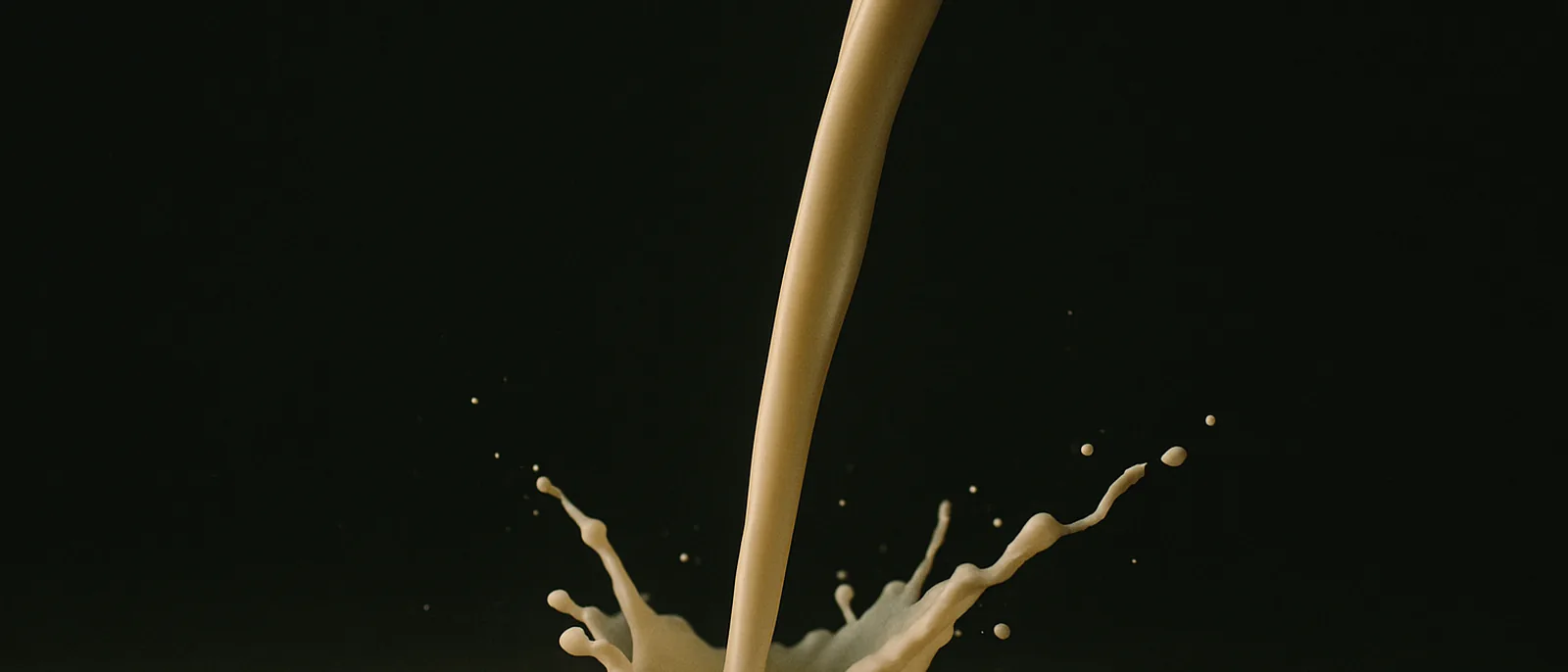
This entry examines Surah an-Nahl 16:66, which describes pure milk drawn 'between excretion and blood,' and the reading that connects this placement to the physiology of lactation established in later centuries.
The source text
وَإِنَّ لَكُمْ فِى ٱلْأَنْعَـٰمِ لَعِبْرَةً ۖ نُّسْقِيكُم مِّمَّا فِى بُطُونِهِۦ مِنۢ بَيْنِ فَرْثٍ وَدَمٍ لَّبَنًا خَالِصًا سَآئِغًا لِّلشَّـٰرِبِينَ
“And indeed, for you in grazing livestock is a lesson. We give you drink from what is in their bellies - between excretion and blood - pure milk, palatable to drinkers.”
Qur'an 16:66 · Saheeh International
What was understood in the seventh century
Milk was a familiar product of livestock in the seventh century, central to the diet of the Arabs, but the pathway of its formation was unknown. There was no account of the role of blood, or of digested material in the gut, in supplying its nutrients, and no way to trace how food became milk. The verse's specific placement of milk 'between excretion and blood' had no observational basis at the time, since the internal processes it points to were invisible.
The verse frames this as 'a lesson' in the grazing livestock: a drink given 'from what is in their bellies,' pure and palatable to those who drink it, yet situated between two things one would ordinarily associate with impurity. The rhetorical effect turns on that contrast, a wholesome drink emerging from between waste and blood.
The modern correspondence
Physiology, clarified from the eighteenth to the twentieth centuries, describes milk as synthesized in the mammary glands from nutrients carried by the bloodstream. Those nutrients are absorbed across the wall of the intestine from the digested contents of the gut, the same material that, further along, yields feces. The mammary glands then draw their raw materials from the blood and assemble milk, which contains none of the waste or the blood as such.
Commentators read 'between excretion and blood' as reflecting this sequence: milk's components derive from digested food in the intestines, pass into the blood, and are drawn from the blood by the mammary glands, so the finished product stands 'between' the two sources while remaining pure. The correspondence argued here is between the verse's placement and the gut-to-blood-to-gland pathway. Supporters stress the ordering of the phrase, 'between excretion and blood,' which they take to name the two stages the nutrients pass through, the digested matter in the gut and then the bloodstream, in the sequence physiology now describes. They also note the insistence that what emerges is 'pure' and 'palatable,' free of any trace of the waste and blood from which its constituents were drawn, which they read as anticipating the selective work of the mammary glands in extracting only certain components. The Britannica entry on lactation, cited below, sets out this nutrient route.
Considerations and counterpoints
Critics argue that the phrase may simply reflect the everyday observation that, inside the animal, the udder lies in the region of the gut and blood-rich tissues, a topographical rather than a biochemical claim. They add that milk is not literally produced 'between' feces and blood as two adjacent substances, and that reading modern lactation physiology into the verse over-specifies what is more plausibly a general and rhetorical expression contrasting purity with its surroundings. The rhetorical aim of the passage, on this account, is to marvel that a wholesome and palatable drink should issue from the interior of an animal, amid waste and blood, as a sign of divine provision; the force of that contrast does not require, and is not improved by, a precise account of nutrient transfer. Critics also caution that the very translation 'between excretion and blood' is one rendering among several, and that building a physiological claim on a particular choice of words compounds the interpretive risk.
Credibility rating: Tier 2 · Interpretive — The 'between excretion and blood' image maps reasonably onto gut-to-blood-to-mammary nutrient transfer, but the phrase is broad and admits a simpler anatomical reading.