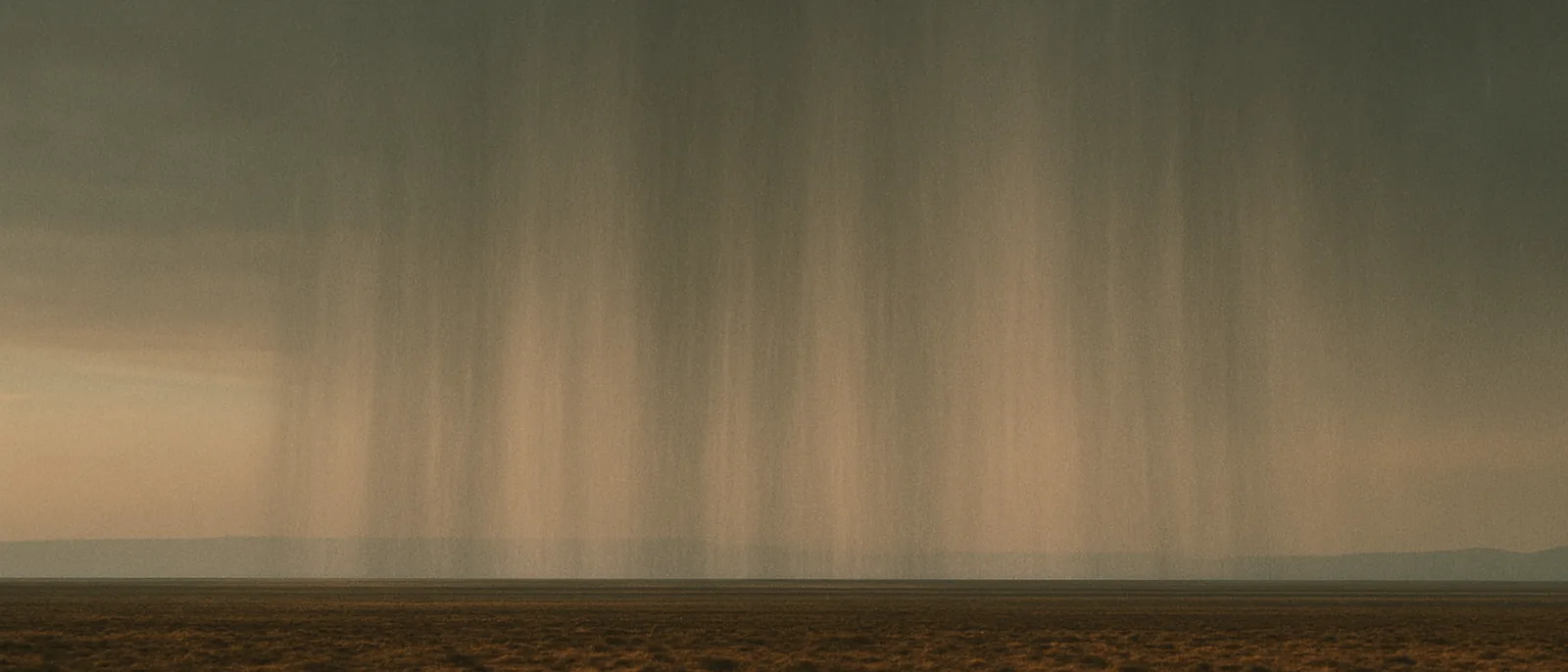
This entry examines the phrase in Surah az-Zukhruf 43:11 that God sends down rain from the sky bi-qadar, "in measured amounts," and asks whether it can bear the weight of a scientific reading. The case here is weak, and rests largely on how a general phrase is construed.
The source text
وَٱلَّذِى نَزَّلَ مِنَ ٱلسَّمَآءِ مَآءًۢ بِقَدَرٍ فَأَنشَرْنَا بِهِۦ بَلْدَةً مَّيْتًا ۚ كَذَٰلِكَ تُخْرَجُونَ
“And who sends down rain from the sky in measured amounts, and We revive thereby a dead land - thus will you be brought forth -”
Qur'an 43:11 · Saheeh International
What was understood in the seventh century
In seventh-century Arabia rain was experienced as unpredictable and God-given, vital for reviving desert vegetation and never to be taken for granted. There was no quantitative concept of a globally balanced water budget, nor of precipitation as a regulated, cyclical quantity. Rain was understood chiefly as an intermittent blessing, sent or withheld.
Against that background, describing rain as sent "in due measure" reads most naturally as a statement about God's provision rather than about a measurable atmospheric quantity. The verse pairs the phrase with the reviving of "a dead land," and closes "thus will you be brought forth," framing the measure within an argument for resurrection. The measure is presented as an act of mercy and power, part of a moral and theological point.
The modern correspondence
Hydrology and climatology describe precipitation as part of a balanced global water budget: the total water that evaporates and returns as precipitation is broadly conserved over time, and average global rainfall is a measurable, roughly steady quantity. In that sense the water that falls is indeed "measured," in aggregate and over the long run.
Some commentators read the repeated Qur'anic phrase that water is sent bi-qadar, which recurs in related verses such as Surah al-Muminun 23:18, as anticipating the idea of a regulated, quantified water cycle rather than arbitrary rainfall. Satellite programmes now measure global precipitation directly, giving the notion of a "measured" rainfall a literal, instrumented sense the period could not have had. The references below document the water cycle and the measurement of precipitation. This correspondence, however, is interpretation-dependent and modest: nothing in the phrase specifies a conserved budget, and the link is drawn by readers who already know the science.
Considerations and counterpoints
Critics argue that "measured" most naturally means "in the right amount by God's decree," a theological rather than meteorological statement, and that describing rain as measured or apportioned requires no scientific insight whatever. Reading a conserved global water budget into the phrase, they say, is anachronistic. The tier assigned here is the site's most cautious: the scientific reading rests on a general phrase that can equally denote providential control, and the entry claims no more than a loose and disputable resonance.
Credibility rating: Tier 3 · Contested — Authentic clear text, but 'in measured amounts' is a general phrase that can equally denote God's providential control, so the scientific reading is interpretation-dependent and modest.