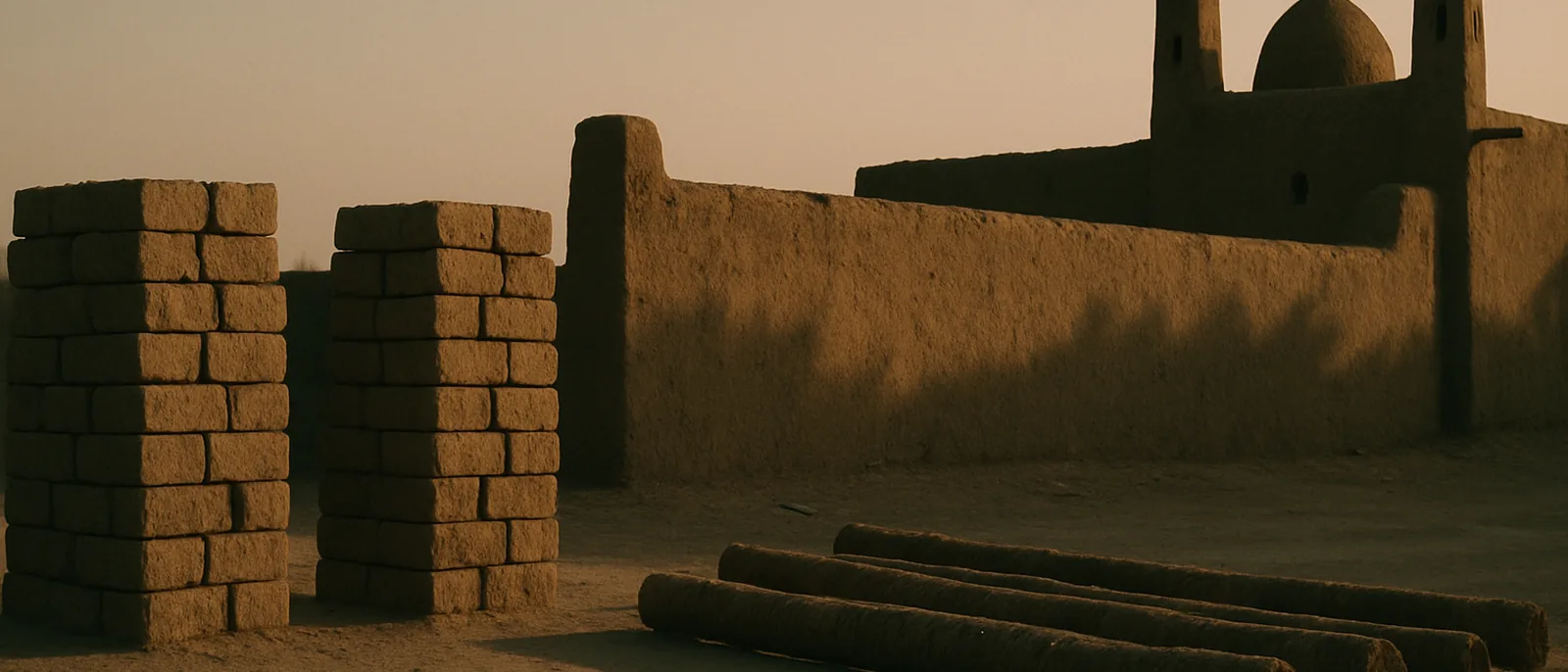
This entry examines the Sahih al-Bukhari narrations in which the Prophet, watching 'Ammar ibn Yasir carry double loads of mudbrick for the first mosque, said that 'Ammar would be killed by "a rebellious aggressive group" while calling his killers to Paradise. Thirty-five years later 'Ammar fell at Siffin, and the hadith's fame reportedly preceded him onto the field.
The source text
“Narrated 'Ikrima: ... He (Abu Sa'id) said, 'We were carrying one adobe at a time while 'Ammar was carrying two. The Prophet (peace be upon him) saw him and started removing the dust from his body and said, "May Allah be Merciful to 'Ammar. He will be inviting them (i.e. his murderers, the rebellious group) to Paradise and they will invite him to Hell-fire." 'Ammar said, "I seek refuge with Allah from affliction."'”
Sahih al-Bukhari 447 · Grading: sahih (Bukhari-Muslim by definition)
“We carried the adobe of the mosque, one brick at a time while 'Ammar used to carry two at a time. The Prophet passed by 'Ammar and removed the dust off his head and said, 'May Allah be merciful to 'Ammar. He will be killed by a rebellious aggressive group. 'Ammar will invite them to (obey) Allah and they will invite him to the (Hell) fire.'”
Sahih al-Bukhari 2812 · Grading: sahih (Bukhari-Muslim by definition)
What was understood in the seventh century
The setting is the construction of the mosque in Medina in 622–623 CE, immediately after the Hijra. The community was tiny, newly settled, and united; the companions were carrying adobe bricks together, 'Ammar carrying two at a time. In that scene of common labor, the Prophet Muhammad (peace be upon him) is reported to have brushed the dust from 'Ammar and said that a rebellious party (al-fi'a al-baghiya) would kill him — he inviting them to Paradise, they inviting him to the Fire.
The content is unusually falsifiable for a seventh-century utterance: a named man, a named manner of death, and a named category of killer, all presupposing that the united community would one day split into warring camps — a prospect with no contemporary plausibility whatever. Two Bukhari versions preserve the saying: one (2812) with the explicit wording that a rebellious aggressive group would kill him, the other (447) with the killers identified through the clause about inviting them to Paradise while they invited him to the Fire.
The fulfillment record
The fulfillment came thirty-five years later. At the Battle of Siffin in 657 CE, 'Ammar — by then in his early nineties — was killed fighting on the side of the caliph 'Ali against Mu'awiya's Syrian army, a dated event of the first civil war recorded in the standard histories cited below. Every element of the saying was by then in place: the named man, death in battle, the killers a party of Muslims in rebellion against the recognized caliph, and 'Ammar calling them to reconciliation until the end.
The sources add a telling detail: consternation broke out in the Syrian camp precisely because this hadith was already famous, and 'Ammar's death appeared to brand that side the transgressors. The improvised reply attributed to the Syrian leadership — that "the one who brought him to the battlefield killed him" — only makes sense if the prediction was circulating before the battle, not composed after it. The identification of the "rebellious party" thereafter became a standard datum in classical discussions of the first fitna.
Considerations and counterpoints
The hadith was committed to writing after Siffin, and it is politically explosive: it effectively condemns Mu'awiya's side. Critics therefore argue that pro-'Ali partisans had strong motive to circulate or shape it, and that the mosque-construction setting could be a later narrative frame lending the words an early date. Defenders counter that the report's very inconvenience argues for it: it survived in Sunni collections compiled under dynasties descended from, or sympathetic to, the Syrian side, transmitted through narrators with no 'Alid agenda — and the reported Siffin-era reactions in both camps indicate the saying predated the battle. On either reading, the narration's preservation against the grain of later politics is the fact most in need of explanation.
Credibility rating: Tier 1 · Strong — Sahih al-Bukhari text with an explicit, specific, falsifiable content (named man, named manner of death, named type of killer) fulfilled at a precisely dated battle.