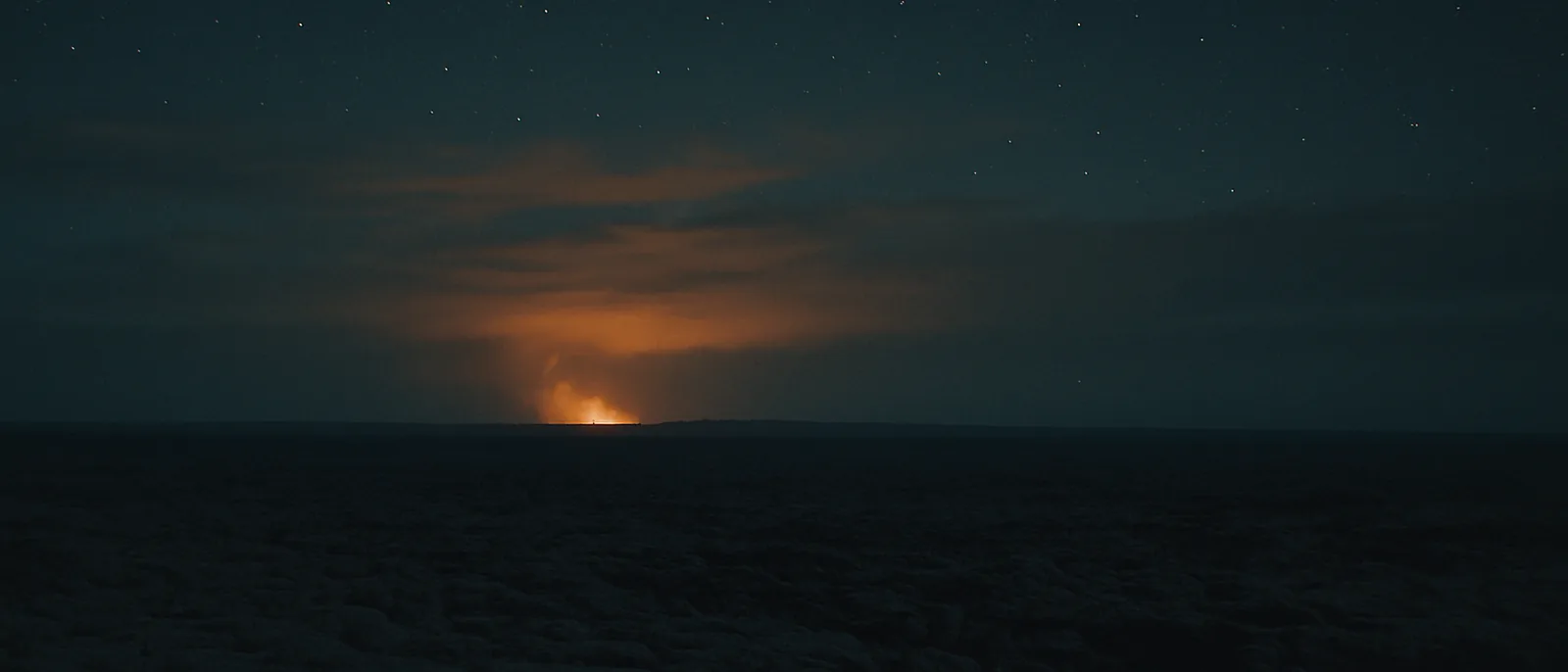
This entry examines the hadith that the Hour will not come "till a fire comes out of the land of Hijaz" that would light the necks of camels at Busra in Syria, and the fissure eruption of the Harrat Rahat volcanic field near Medina in 1256 CE that Muslim chroniclers and modern geology alike record. The framing matters: this is a sign-of-the-Hour text whose named precursor event is argued to have occurred.
The source text
لاَ تَقُومُ السَّاعَةُ حَتَّى تَخْرُجَ نَارٌ مِنْ أَرْضِ الْحِجَازِ تُضِيءُ أَعْنَاقَ الإِبِلِ بِبُصْرَى
“The Hour will not be established till a fire will come out of the land of Hijaz, and it will throw light on the necks of the camels at Busra.”
Sahih al-Bukhari 7118 · Grading: sahih (Bukhari-Muslim by definition)
“The Last Hour would not come until fire emits from the earth of Hijaz which would illuminate the necks of the camels of the Busra.”
Sahih Muslim 2902 · Grading: sahih (Bukhari-Muslim by definition)
What was understood in the seventh century
The narration appears in both Sahih al-Bukhari (7118) and Sahih Muslim (2902). In the lifetime of the Prophet Muhammad (peace be upon him) the Hijaz had no recorded volcanic activity; the harrat lava fields east of Medina were ancient and quiescent, and seventh-century Arabs had no conception of their region as volcanically live ground.
The text also names a viewing point. Busra (Bostra) is a town in southern Syria roughly 1,100 kilometres north of Medina — the caravan terminus Meccan traders knew. A fire in the Hijaz visible, in some sense, from Busra is a claim of scale, not merely of occurrence — and it fixes the fire's origin in one named region and its visibility at one named town, both checkable if the event ever came.
The fulfillment record
In June–July 1256 CE (654 AH) a fissure eruption of the Harrat Rahat field opened about 20 kilometres southeast of Medina, producing a 23-day eruption and a lava flow of roughly half a cubic kilometre that advanced toward the city and stopped short of it. The event is fixed in the modern geological record: the Smithsonian Global Volcanism Program and a 2023 U.S. Geological Survey professional paper, both in the references below, date the field's youngest historical eruption to 1256 CE.
The medieval documentation is independently rich. Contemporary Muslim chroniclers — al-Nuwayri, Abu Shama writing in Damascus, and later al-Samhudi — describe the fire, and several report that its glow was seen from as far away as Syria, including claims that it lit the region of Busra. Al-Nawawi, a contemporary, wrote that knowledge of this fire was transmitted en masse (tawatur) from those who witnessed it. The correspondence argued here joins a sahih seventh-century text to a thirteenth-century eruption documented from two directions: stratigraphy and chronicle.
Considerations and counterpoints
Skeptics make two points. First, western Arabia is in fact a volcanically active region — the geological record includes an eruption in Harrat Rahat around 641 CE, within a decade of the Prophet's death — so predicting that fire would one day emerge from the Hijaz was not physically far-fetched. Second, the distinctive Busra detail is the least secure: direct illumination of objects 1,100 kilometres away is physically questionable, and reports of distant visibility could reflect pious conformity of chroniclers to a well-known hadith rather than observation. Defenders cite atmospheric reflection off clouds, the Damascus-based testimony of Abu Shama, and the mass transmission al-Nawawi records. It should also be said plainly that the hadith frames the fire as a precursor of the Hour, not a stand-alone prediction; the entry presents it in that frame.
Credibility rating: Tier 2 · Interpretive — Sahih text plus a geologically documented eruption is strong, but the distinctive 'Busra' detail rests on medieval testimony whose optics are contested, so the item is tiered conservatively.