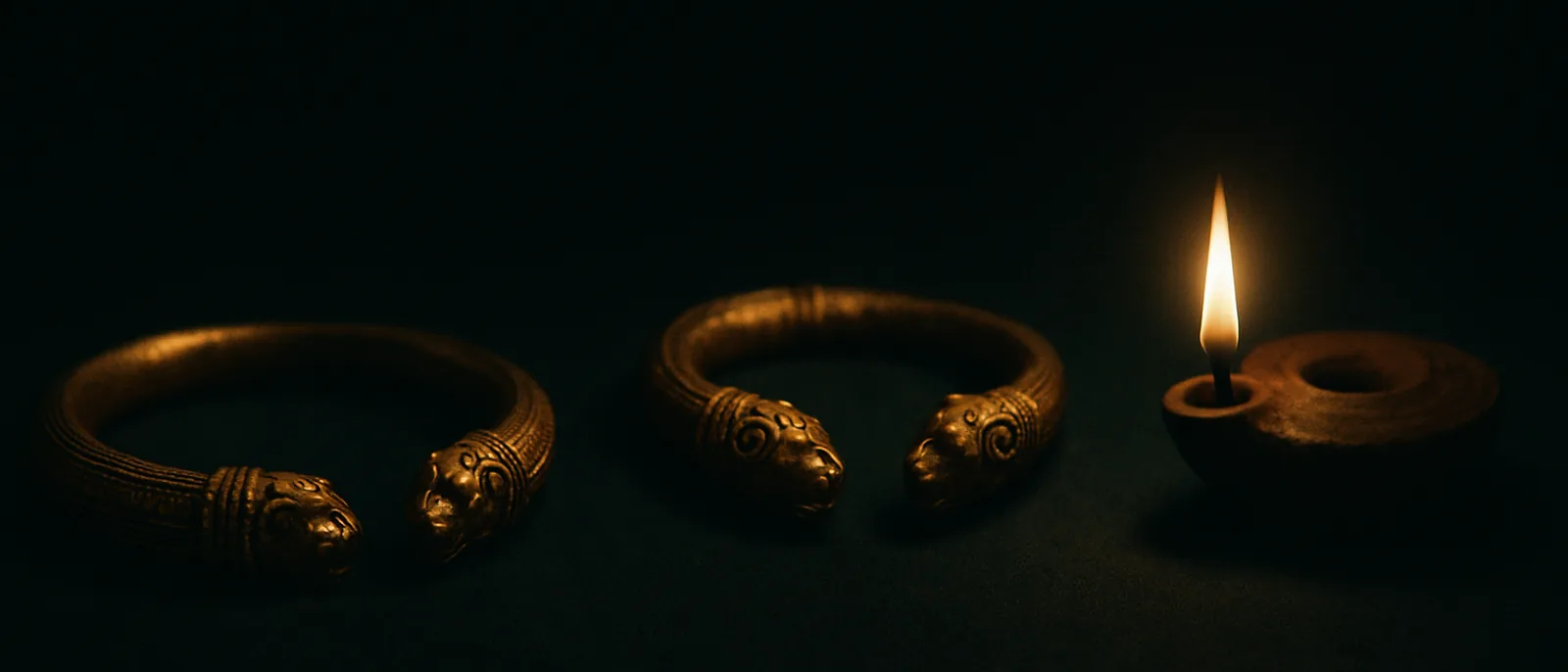
This entry examines the famous story that Suraqa ibn Malik, the bounty hunter who pursued the Prophet during the Hijra, was promised the royal bracelets of Chosroes — and received them from the caliph 'Umar some fifteen years later. The case here rests on disputed narrations: the promise itself is not found in the canonical collections, and the entry is framed accordingly.
The source text
“During the Hijra pursuit, after Suraqa ibn Malik's horse repeatedly sank in the sand and he sought amnesty, the Prophet (peace be upon him) is reported to have said to him words to the effect: 'How will it be with you, O Suraqa, when you wear the two bracelets of Kisra?' Decades later, when the spoils of the Persian capital reached Medina, 'Umar ibn al-Khattab is reported to have summoned Suraqa and placed Kisra's bracelets on his arms.”
al-Bidaya wa'n-Nihaya (Ibn Kathir) and al-Isaba (Ibn Hajar); the promise is not found in the Six Books · Grading: disputed (chains criticized as weak or disconnected by hadith specialists; the underlying pursuit story (without the bracelet promise) is in Sahih al-Bukhari 3906)
What was understood in the seventh century
The setting is 622 CE. The Prophet Muhammad (peace be upon him) was fleeing Mecca with a price on his head, and Suraqa, a tribesman of Banu Mudlij, rode out to collect it. The rigorously authenticated account of the pursuit — Sahih al-Bukhari 3906 — relates that Suraqa's horse repeatedly sank in the sand and that he finally sought amnesty. In the version transmitted in later biographical and historical works such as Ibn Kathir's al-Bidaya wa'n-Nihaya and Ibn Hajar's al-Isaba, the encounter closes with words to the effect: "How will it be with you, O Suraqa, when you wear the two bracelets of Kisra?"
At that moment Kisra — Khosrow II — ruled the wealthiest empire in western Asia. A promise that a bedouin bounty hunter would wear the Persian emperor's regalia, made by a fugitive fleeing his own city, was extravagant beyond measure.
The fulfillment record
The fulfillment scene is widely transmitted in the historical literature. Ctesiphon, the Sasanian capital, fell to Muslim forces in 637 CE, and its treasury — including royal regalia — was sent to Medina. Historical works including al-Tabari's History relate that around 16 AH (c. 637 CE) the caliph 'Umar publicly summoned Suraqa and placed Kisra's bracelets, belt, and crown on him, praising God who had stripped them from Khosrow and placed them on a bedouin of Banu Mudlij. Suraqa died shortly after 'Uthman's accession, around 645 CE.
If both halves of the story are accepted, the correspondence is exact: a named man, a named emperor's bracelets, and a public investiture within the promised man's lifetime. The weight the entry can bear, however, depends entirely on the documentary status of the promise, discussed below.
Considerations and counterpoints
The strongest objection is documentary, and it is serious. The bracelet promise appears only in later biographical and historical compilations whose chains hadith specialists grade as weak (da'if) or disconnected; it does not appear in the Six Books, and the sahih version of the pursuit story contains no such promise. Critics therefore treat the bracelet element as a later embellishment, retrojected after the spoils of Ctesiphon made the image irresistible. On the available evidence that reading cannot be excluded, and this site tiers the item accordingly: the pursuit is authenticated, the investiture is broadly attested history, but the predictive link between them rests on disputed narration.
Credibility rating: Tier 3 · Contested — The story is famous and the fulfillment scene is widely transmitted in historical literature, but the prophetic promise itself lacks a verifiable sahih chain and does not appear in the canonical collections.