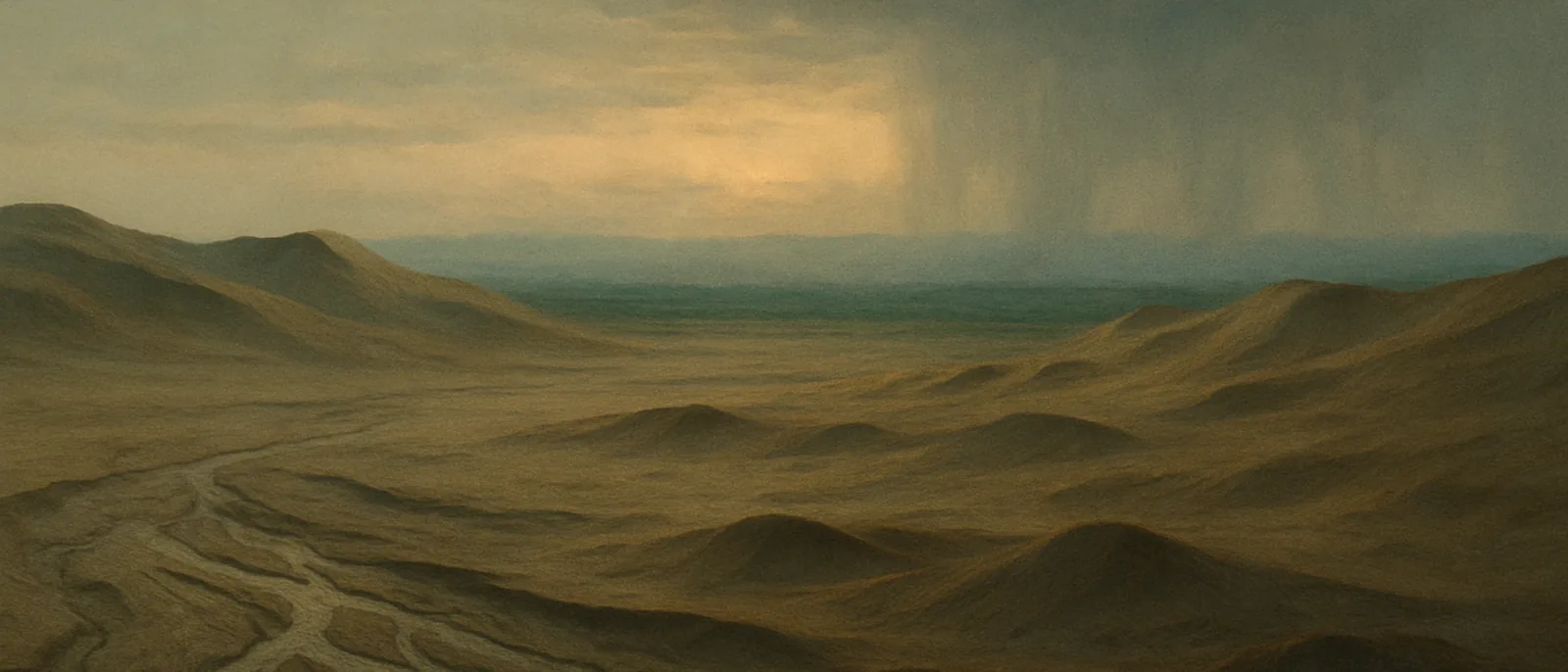
This entry examines the clause of Sahih Muslim 157c that the Hour will not come 'till the land of Arabia reverts to meadows and rivers'. Two distinct questions arise: whether the word 'reverts' aligns with what paleoclimate science has established about a once-green Arabia, and whether the foretold return has occurred. The second answer is no, and the entry keeps the two strictly separate.
The source text
حَتَّى تَعُودَ أَرْضُ الْعَرَبِ مُرُوجًا وَأَنْهَارًا
“The Last Hour will not come before wealth becomes abundant and overflowing... and till the land of Arabia reverts to meadows and rivers.”
Sahih Muslim 157c · Grading: sahih (Bukhari-Muslim by definition)
What was understood in the seventh century
The narration is sahih, transmitted in Sahih Muslim's Book of Zakat, where the Prophet Muhammad (peace be upon him) links the approach of the Hour to overflowing wealth and to Arabia becoming meadows and rivers. The verb is noteworthy: ta'ud means 'reverts' or 'returns', framing a green Arabia as the restoration of a former state. The clause sits in the same narration as the overflowing-wealth prophecy treated elsewhere in this section, and shares its structure: the Hour delayed until a named transformation occurs.
Seventh-century Arabia was hyper-arid apart from scattered oases. It had no permanent rivers, and its inhabitants' entire recorded memory was of desert; no one possessed systematic knowledge that the peninsula had ever been otherwise. What a seventh-century hearer could and could not have inferred is contested, and the considerations below turn on exactly this point.
The fulfillment record
On the first question, paleoclimate research has established that Arabia repeatedly was green. Cave mineral (speleothem) records published in Nature in 2025 document recurrent humid phases over the past eight million years (see the Max Planck release), and earlier work mapped thousands of extinct lakes, rivers, and grasslands — 'Green Arabia' — during the Holocene humid period as recently as about six thousand years ago (Eos). Commentators have noted that this is consistent with the hadith's choice of 'reverts'. The research programme has also traced early human movement through these vanished green corridors, which is why the findings command broad scientific attention.
On the second question, the foretold return itself has not occurred. Present greening around Saudi and Emirati projects is driven by irrigation, desalination, and cloud seeding, and while some climate-model projections suggest increased rainfall over parts of the peninsula under warming scenarios, those projections diverge by model and scenario. A natural restoration of meadows and rivers remains unobserved, so the entry is part knowledge-alignment and part awaited prediction — not a fulfillment. Keeping the two questions separate is the entry's whole discipline: the alignment of a verb with paleoclimate is one claim, a future natural transformation is another, and only the first has evidence behind it.
Considerations and counterpoints
Skeptics reply that seventh-century Arabs could infer a wetter past from visible evidence — dry riverbeds (wadis), Neolithic rock art of cattle and hippopotamus, and oasis lore — so 'reverts' need not imply hidden knowledge. They add that citing irrigation-driven greening or seasonal desert blooms as incipient fulfillment is a category error, and that the divergence of climate projections means the future claim cannot be scored yet. Both sides, notably, agree on the underlying science; the dispute is over what the seventh-century wording can be said to have known.
Credibility rating: Tier 2 · Interpretive — Authentic text whose 'reverts' wording aligns with well-established paleoclimate findings, but the predicted future transformation is unobserved and the alignment argument is interpretation-dependent.