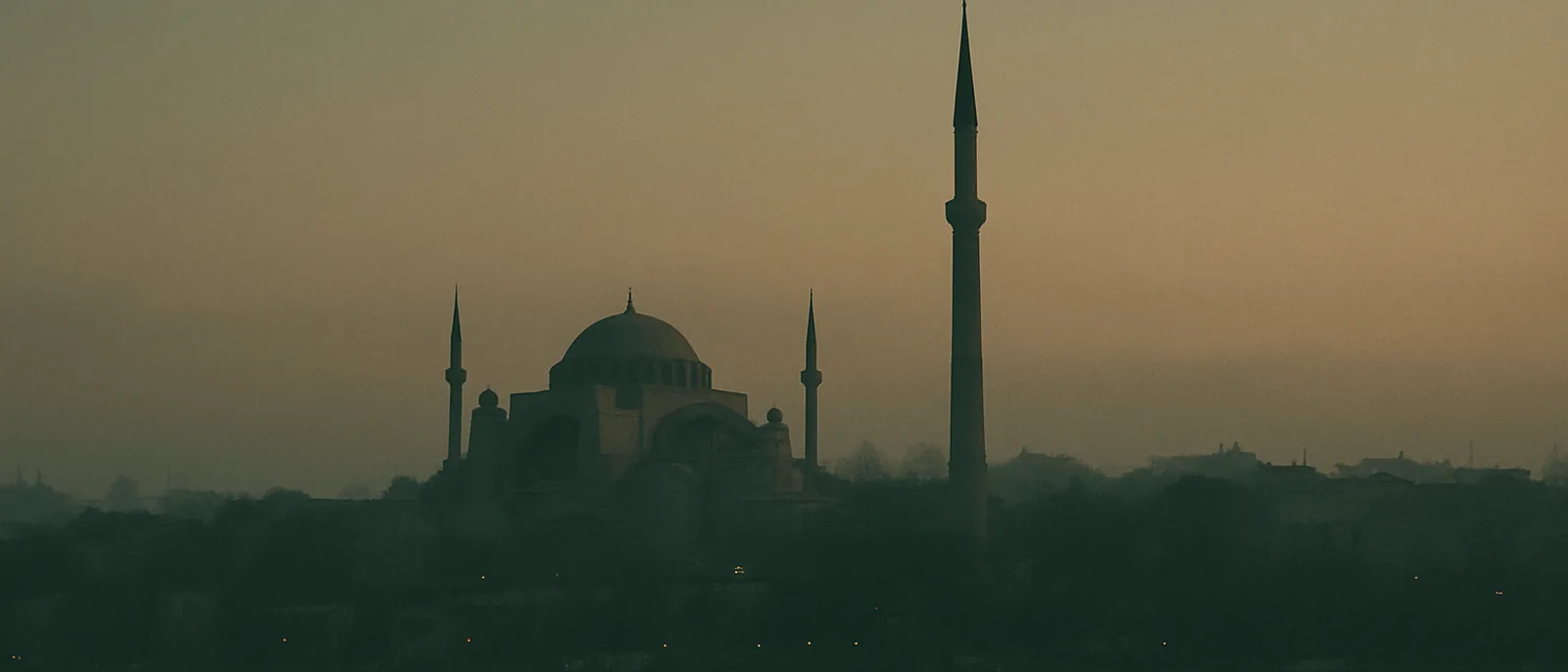
This entry examines two narrations — Sunan Abi Dawud 449 and Sunan an-Nasa'i 689 — foretelling that before the Hour people will vie with one another over mosques and show off in building them. It sets the founding austerity of the first mosque against the superlative-driven mosque architecture of the present day. The narrations are brief, but their fulfillment record is among the longest documented in this section.
The source text
“The Last Hour will not come until people vie with one another about mosques.”
Sunan Abi Dawud 449 · Grading: sahih (al-Albani)
“One of the portents of the Hour will be that people will show off in building Masjids.”
Sunan an-Nasa'i 689 · Grading: sahih (Darussalam)
What was understood in the seventh century
Both narrations are graded sahih — the Abu Dawud text by al-Albani, the an-Nasa'i text by Darussalam. The first states that the Last Hour will not come until people vie with one another about mosques; the second counts showing off in building mosques among the portents of the Hour. Both compilers placed the reports in chapters on mosques, signalling that they read the vying concretely — as competition in the buildings themselves rather than a vague metaphor.
The mosque of the Prophet Muhammad (peace be upon him) in Medina was a courtyard of palm trunks and mud walls, and early Islamic piety prized austerity in worship spaces. Predicting that the community's own houses of worship would become arenas of competitive ostentation cut directly against the founding aesthetic. That austerity was not poverty alone but example: the founding house of worship deliberately claimed nothing for itself, and early narrations record discomfort with mosque ornamentation among the first generations — so the prediction was preserved by the very tradition it criticized in advance.
The fulfillment record
Monumental mosque-building is now an arena of explicit national rivalry. Algeria's Djamaa el Djazair, inaugurated in February 2024, was promoted as holding the world's tallest minaret at about 265 meters and Africa's largest prayer hall, in publicized competition with Morocco's Hassan II Mosque (see the Al Jazeera report); Gulf states have built successive 'largest' and 'most expensive' mosques, and expansions of the Grand Mosque in Mecca are announced in superlatives. The superlatives are not incidental marketing but the projects' stated identity: tallest minaret, largest prayer hall, greatest expense, each announced against a named rival's record.
Classical commentators — and the chapter headings of the Sunan compilers — read the hadith as covering both ornamentation and boasting, and note that the trend began with the Umayyads. On that reading, the modern examples continue a long-running correspondence rather than initiating one. That long continuity cuts both ways, and the considerations below give the skeptical edge of it.
Considerations and counterpoints
Skeptics note that magnificent temple-building is a human universal, and that lavish mosques appeared within decades of the Prophet's death — the Umayyad Mosque of Damascus was completed in 715. A prediction fulfilled so quickly and so continuously, they argue, reads less like foreknowledge of a distant development and more like an early observation of institutional religion's ordinary trajectory. Defenders answer that early fulfillment does not disqualify a prophecy — the text says only that the vying will precede the Hour, not that it will begin late — but a sign fulfilled everywhere and always is hard to distinguish from a truism. The entry records both positions.
Credibility rating: Tier 2 · Interpretive — Authenticated narrations with a plainly observable ongoing correspondence, tempered by the fact that grand religious architecture emerged early and everywhere, making the prediction's distinctiveness debatable.