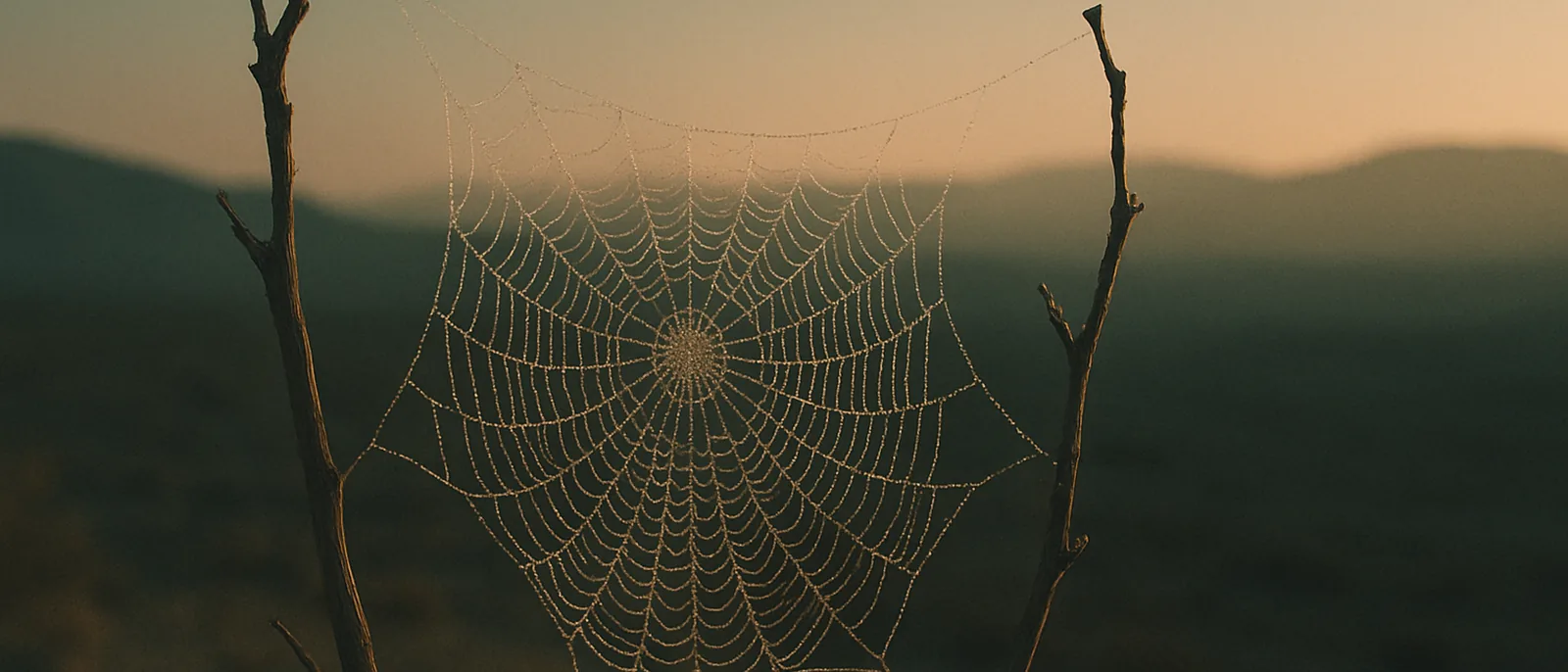
This entry examines the parable of the spider's house in Surah al-Ankabut 29:41. It looks at both the feminine verb used for the web-builder and the description of that house as "the weakest of homes," and how each reads against modern arachnology.
The source text
مَثَلُ ٱلَّذِينَ ٱتَّخَذُوا۟ مِن دُونِ ٱللَّهِ أَوْلِيَآءَ كَمَثَلِ ٱلْعَنكَبُوتِ ٱتَّخَذَتْ بَيْتًا ۖ وَإِنَّ أَوْهَنَ ٱلْبُيُوتِ لَبَيْتُ ٱلْعَنكَبُوتِ ۖ لَوْ كَانُوا۟ يَعْلَمُونَ
“The example of those who take allies other than Allāh is like that of the spider who takes [i.e., constructs] a home. And indeed, the weakest of homes is the home of the spider, if they only knew.”
Qur'an 29:41 · Saheeh International
What was understood in the seventh century
A spider's web was known in seventh-century Arabia to be flimsy and easily swept away, and that familiar image supplies the surface meaning of the parable: those who take protectors besides God rely on something as insubstantial as a web. At this everyday level the comparison needs no special knowledge; the fragility of a web is plain to anyone who brushes one aside.
Beyond that surface image, however, the internal social structure of spiders and the nature of the silk they spin were not matters of documented knowledge. The grammar of the verse is also more specific than the general picture. It makes the web-builder feminine, ittakhadhat ("she took" or "she constructed"), rather than using a masculine or indefinite form for whichever spider makes the home. As with the bee, Arabic requires the verb to declare a gender, and the form chosen here is feminine throughout.
The modern correspondence
Modern arachnology finds that in the great majority of web-spinning spiders it is the female that builds and maintains the capture web, while males typically abandon web-building on reaching maturity and wander in search of mates, often at considerable risk to themselves. The feminine verb in 29:41 is consistent with this division of labour between the sexes.
Commentators have also drawn attention to a second layer in the phrase "the weakest of homes." Although spider silk is, weight for weight, a very strong fibre, the web considered as a dwelling and a social structure is fragile: it offers no real shelter, is repeatedly destroyed and rebuilt, and sustains no stable family bond, matching the parable's argument about the frailty of false attachments. On this reading the verse's target is the home as protection and relationship, not the tensile properties of the thread. A web keeps out neither weather nor predator, is torn and rebuilt again and again, and houses a solitary and often cannibalistic occupant rather than a settled family, so as a dwelling it is genuinely among the frailest. Both the feminine builder and the structural weakness of the web as a household are consistent with what is now known.
Considerations and counterpoints
Critics note that al-ankabut is grammatically feminine, so feminine agreement is expected regardless of biology, and that the observation about female web-builders may simply be reading arachnology into ordinary grammatical agreement. They add that spider silk's remarkable strength appears to sit awkwardly with calling the house "weakest," and that defenders resolve the tension only by shifting the meaning of "weakest" from the fibre to the home as shelter and bond, which is an interpretive move rather than something the text states. As with the bee, the strength of the reading depends on how much a genuinely feminine verb is asked to carry, and on accepting the second, social sense of "weakest."
Credibility rating: Tier 2 · Interpretive — Clear authentic text with a genuinely feminine verb that matches female web-building, but as with the bee the argument leans on grammatical gender and on how one weighs silk's tensile strength against the 'weakest of homes' description.