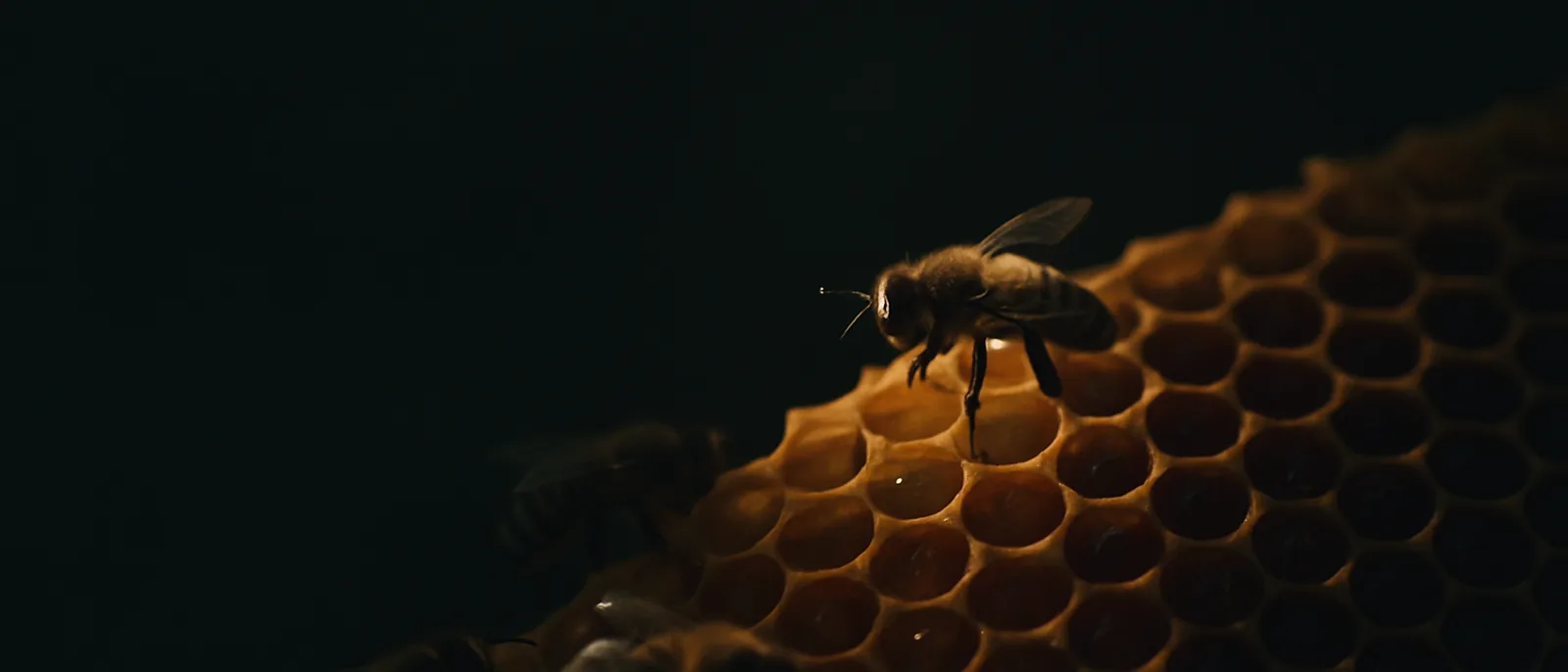
This entry examines the grammatical form of the commands addressed to the bee in Surah an-Nahl 16:68-69. The question is whether their feminine gender tracks the biological fact that the bees which build comb, forage among fruits and produce honey are all workers, and all female.
The source text
وَأَوْحَىٰ رَبُّكَ إِلَى ٱلنَّحْلِ أَنِ ٱتَّخِذِى مِنَ ٱلْجِبَالِ بُيُوتًا وَمِنَ ٱلشَّجَرِ وَمِمَّا يَعْرِشُونَ
“And your Lord inspired to the bee, "Take for yourself among the mountains, houses [i.e., hives], and among the trees and [in] that which they construct."”
Qur'an 16:68 · Saheeh International
ثُمَّ كُلِى مِن كُلِّ ٱلثَّمَرَٰتِ فَٱسْلُكِى سُبُلَ رَبِّكِ ذُلُلًا ۚ يَخْرُجُ مِنۢ بُطُونِهَا شَرَابٌ مُّخْتَلِفٌ أَلْوَٰنُهُۥ فِيهِ شِفَآءٌ لِّلنَّاسِ ۗ إِنَّ فِى ذَٰلِكَ لَـَٔايَةً لِّقَوْمٍ يَتَفَكَّرُونَ
“Then eat from all the fruits and follow the ways of your Lord laid down [for you]. There emerges from their bellies a drink, varying in colors, in which there is healing for people. Indeed in that is a sign for a people who give thought.”
Qur'an 16:69 · Saheeh International
What was understood in the seventh century
In the ancient and classical world the bee colony was commonly imagined as ruled by a male. The notion of a "king bee" persisted in learned thought from Aristotle through the medieval period, and the foraging, comb-building bees were not popularly identified as exclusively female. Ordinary observation could reveal bees leaving and returning to the hive, gathering from flowers and filling the comb, but it could not disclose the sex of those performing the work, which requires close study of the insects' anatomy and the internal organisation of the colony.
Arabic grammar, by contrast, makes the gender of a command explicit. An imperative or a verb addressed to a subject must carry either a masculine or a feminine form, and there is no neutral option. Any instruction directed to the bee that forages and constructs comb therefore had to be cast one way or the other, and the choice made is visible on the surface of the text. The verses address a single class of bee and describe precisely the activities of building, foraging and producing the "drink" that issues from its body.
The modern correspondence
The commands in 16:68-69 are given in the feminine, for example ittakhidhi ("take"), kuli ("eat") and fasluki ("follow"). Modern apiology, established from the seventeenth century once the microscope allowed the colony to be studied closely, confirms that all foraging worker bees and comb-builders are non-reproductive females. The only males in the hive, the drones, neither forage, build comb, nor produce honey; their role is confined to reproduction, and outside the mating season they are not even retained by the colony.
Commentators have noted that the feminine forms in these verses therefore correspond to the biological reality of which bees perform this labour. The honey described as "a drink, varying in colours, in which there is healing for people" is addressed in the medicine material, where the healing claim is assessed on its own terms. The point isolated in this entry is narrower: that the grammatical address in the verse aligns with the sex of the bees that actually do the building and foraging, a fact that could not be established until the colony was examined under magnification.
Considerations and counterpoints
Critics respond that Arabic assigns grammatical gender to the noun nahl (bee), and that verbal agreement follows the word rather than making any claim about the insects' sex. On this view the feminine is a routine linguistic feature, and a masculine noun for the same insect would have produced masculine agreement without any change in meaning. Defenders counter that the sustained feminine address still coincides with the facts of the colony, but the correspondence depends on treating grammatical gender as a deliberate biological statement rather than a default of the language. The healing clause, meanwhile, overlaps with pre-modern folk uses of honey and is treated elsewhere. The entry is best read as an authentic and clear text whose force rests on how much weight one is willing to place on grammatical gender.
Credibility rating: Tier 2 · Interpretive — Authentic and clear text with a genuinely feminine grammatical form, but the reading depends on treating grammatical gender as a deliberate biological statement rather than a linguistic default.