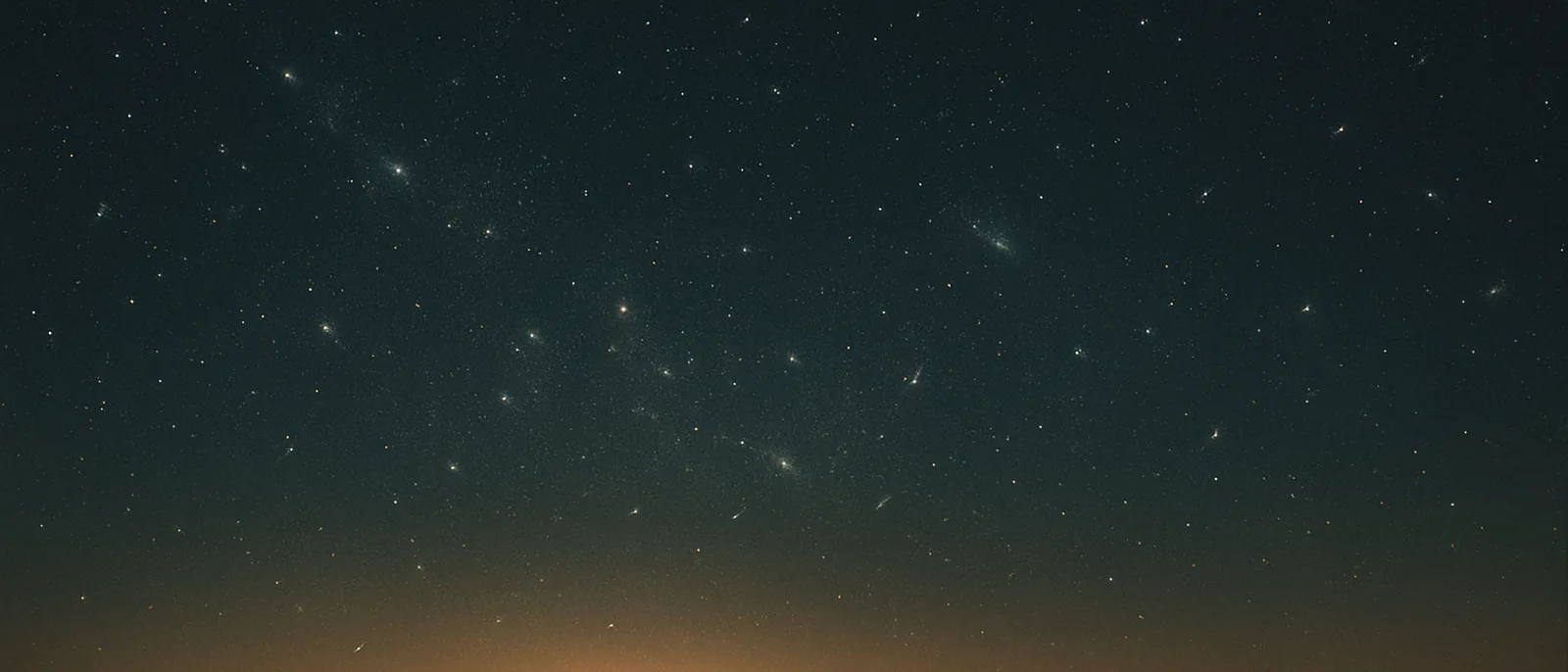
This entry examines the closing phrase of Surah adh-Dhariyat 51:47, in which the builder of the heaven declares “We are [its] expander,” and the argument that this wording corresponds to the twentieth-century discovery that the universe is expanding.
The source text
وَٱلسَّمَآءَ بَنَيْنَـٰهَا بِأَيْي۟دٍ وَإِنَّا لَمُوسِعُونَ
“And the heaven We constructed with strength, and indeed, We are [its] expander.”
Qur'an 51:47 · Saheeh International
What was understood in the seventh century
When this ayah was recited by the Prophet Muhammad (peace be upon him) in seventh-century Arabia, every cosmology within reach of his audience treated the heavens as fixed in size. The Ptolemaic system known to Byzantine and Persian scholars, like the folk astronomy of the Hijaz, pictured a completed sky; Aristotle's model of eternal, static celestial spheres dominated learned thought from Greece to Persia. No known tradition of the period described the sky as something growing or being enlarged. The heavens could be layered, solid, or filled with spirits, but their overall scale was taken as given at creation and permanent thereafter.
The assumption of a static cosmos proved remarkably durable. It persisted in Western science into the twentieth century, and Einstein himself initially added a cosmological constant to his equations precisely to keep the universe static. Against that background, a text asserting ongoing enlargement of the heaven would have had no contemporary parallel.
The modern correspondence
The static picture collapsed within a single decade. In 1922 Alexander Friedmann derived expanding-universe solutions from general relativity, and in 1927 Georges Lemaître proposed that the universe is in fact expanding. In 1929 Edwin Hubble published observations showing that distant galaxies recede from us with velocities proportional to their distance — Hubble's law — establishing that space itself is stretching, a result summarized in NASA's WMAP material on cosmic expansion. In 1998 two supernova teams found that the expansion is accelerating, work recognized with the 2011 Nobel Prize in Physics.
Commentators have noted that the active participle musi'un, from awsa'a (“to widen, to make vast”), can be read as “We are surely expanding it” — a present, continuous sense that matches the modern finding. Because the word is a nominal participle rather than a past-tense verb, proponents argue that it naturally bears a continuing sense — an ongoing act of widening rather than a completed one. Saheeh International and several other modern translations render the verse this way, and the correspondence argued here has made 51:47 the most widely cited item in this section.
Considerations and counterpoints
The main objection concerns the history of interpretation. Classical commentators such as at-Tabari and Ibn Kathir generally read musi'un as “possessors of vast power” or “able to enlarge,” or as a reference to God enriching creation through rain and provision — not as ongoing spatial expansion. The expansion reading became common only after Hubble, and critics therefore argue that an ambiguous participle was re-translated once the science was known. They also note that the verse's parallel clause speaks of building the heaven “with strength,” which suits a statement of divine power rather than a claim about cosmology.
A further caution concerns method: a single participle carries the entire claim, and the verse offers no rate, mechanism, or observable consequence that could distinguish foreknowledge from a fortunate turn of phrase. Proponents reply that the question is not whether the verse teaches cosmology in detail but whether its wording, read naturally, is consistent with what was later found — and that the classical commentators' silence about expansion reflects their own cosmological horizon rather than the limits of the Arabic. Readers can weigh the linguistic plausibility of the modern rendering against this interpretive history using the references below.
Credibility rating: Tier 2 · Interpretive — The correspondence with cosmic expansion is well documented and the Arabic is linguistically plausible, but the expansion reading is interpretation-dependent because classical exegesis understood the word differently.