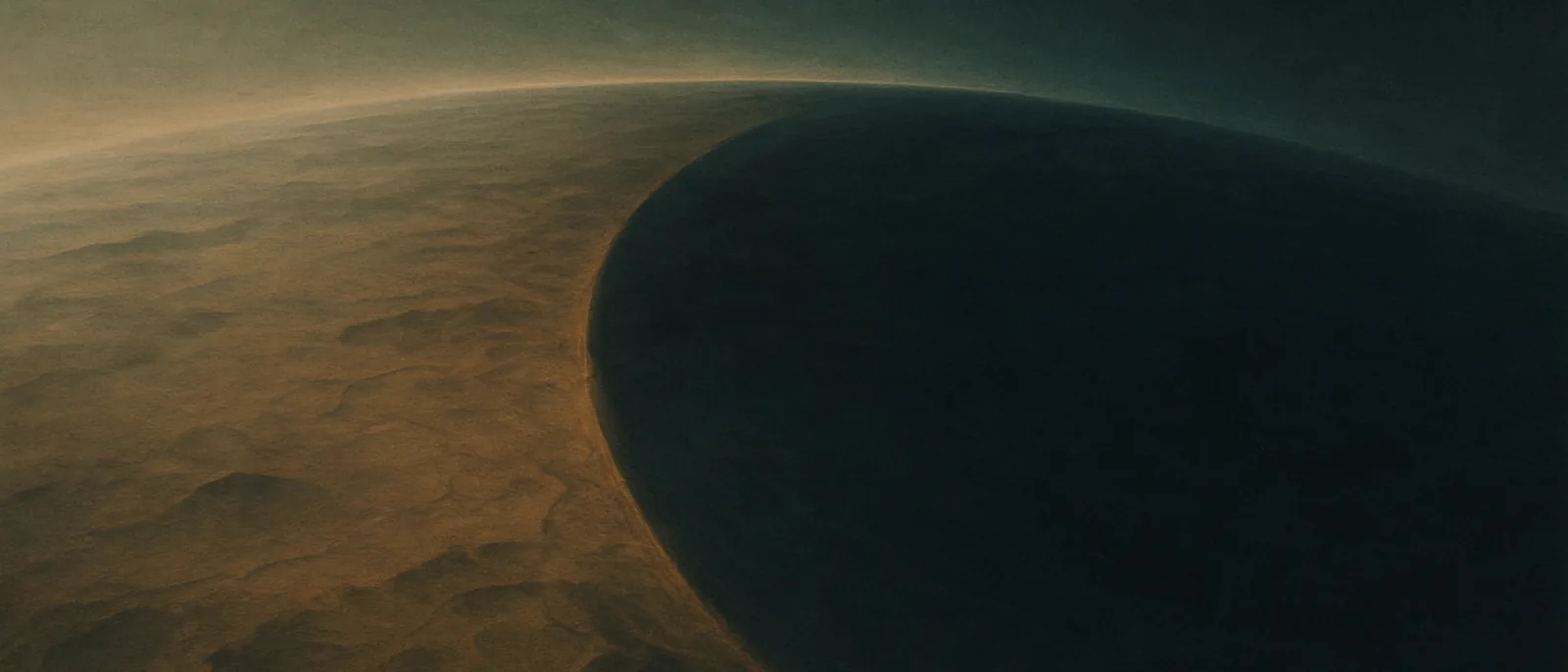
This entry examines Surah az-Zumar 39:5, which says God “wraps the night over the day and wraps the day over the night” (yukawwiru), and the argument that this verb of coiling suits the day-night cycle of a rotating, rounded earth.
The source text
خَلَقَ ٱلسَّمَـٰوَٰتِ وَٱلْأَرْضَ بِٱلْحَقِّ ۖ يُكَوِّرُ ٱلَّيْلَ عَلَى ٱلنَّهَارِ وَيُكَوِّرُ ٱلنَّهَارَ عَلَى ٱلَّيْلِ ۖ وَسَخَّرَ ٱلشَّمْسَ وَٱلْقَمَرَ ۖ كُلٌّ يَجْرِى لِأَجَلٍ مُّسَمًّى ۗ أَلَا هُوَ ٱلْعَزِيزُ ٱلْغَفَّـٰرُ
“He created the heavens and earth in truth. He wraps the night over the day and wraps the day over the night and has subjected the sun and the moon, each running [its course] for a specified term. Unquestionably, He is the Exalted in Might, the Perpetual Forgiver.”
Qur'an 39:5 · Saheeh International
What was understood in the seventh century
Seventh-century cosmology in Arabia assumed a flat or vaguely extended earth beneath a domed sky; day and night were pictured as arriving and departing wholesale, or as the sun being hidden. Greek science had established the earth's sphericity long before — Eratosthenes measured its circumference around 240 BC — but there is no evidence this technical geography circulated in the Hijaz, and the day-night cycle as a moving terminator on a globe was conceptually unavailable to the first audience of the Prophet Muhammad (peace be upon him).
The verb chosen here is specific: kawwara classically means to wind or coil something around a rounded object, and was used of winding a turban. Classical dictionaries preserve exactly that gloss, and it is the specificity of the image — winding around something rounded — that modern readers press, since Arabic had plainer verbs available for mere covering or succession.
The modern correspondence
The earth is a rotating spheroid, completing one rotation in about 24 hours, so the boundary between day and night — the terminator — continuously wraps around a curved surface; each hemisphere's night coils over the day zone and vice versa without interruption. The earth's rotation was definitively demonstrated to a general public by Foucault's pendulum in 1851, and the modern picture is summarized in the references below, including NASA's earth fact page.
Commentators from the modern period have argued that takwir is a strikingly apt verb for these mechanics: wrapping implies a rounded body, and the reciprocal, continuous phrasing — night over day and day over night — fits a globe on which both are always somewhere in progress. Photographs of the earth from space — a vantage no earlier century possessed — show the wrapping almost literally, a curved band of twilight sliding around a sphere. The reciprocity of the verse's two clauses — each wrapped over the other in turn — is read as matching a rotation that never halts. On this reading the verse's imagery only discloses its full sense once the earth's shape and rotation are known.
Considerations and counterpoints
Critics respond that the core sense of kawwara is simply to wind or fold one thing over another, and classical commentators explained the verse as night covering or succeeding day with no reference to a spherical earth. They add that other Qur'anic passages describe the earth as spread out like a bed or carpet (20:53, 71:19), which skeptics take as flat-earth imagery, making the takwir argument selective about which verses count. And since Greek sphericity predates the Qur'an by a millennium, even a spherical reading would not be knowledge unavailable in late antiquity generally. The inference from a single verb is suggestive rather than demonstrative; a fair verdict must also account for the spread-out-earth verses rather than setting them aside, which is why the entry carries an interpretive rating rather than a stronger one.
Credibility rating: Tier 2 · Interpretive — The verb choice is genuinely suggestive of wrapping around a rounded body, but the sphericity inference is drawn from a single word and classical exegesis did not read it that way.