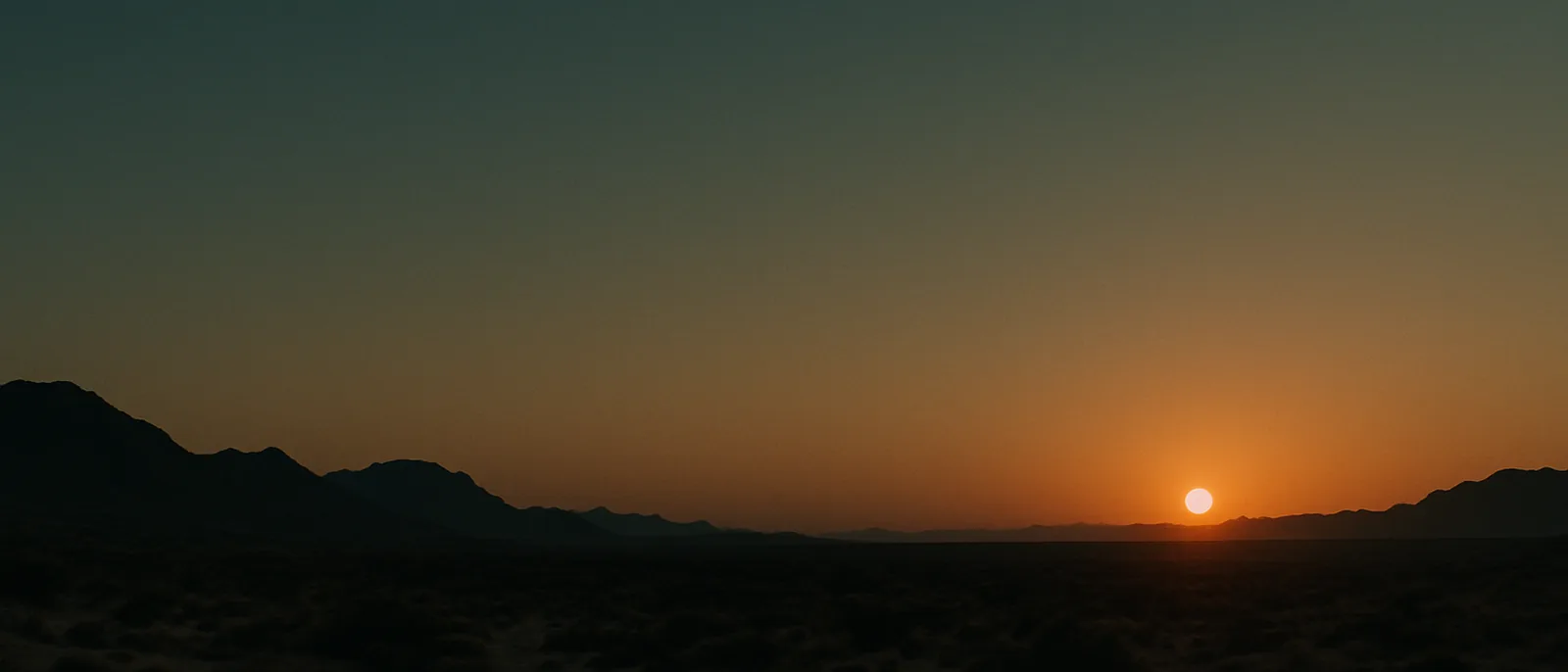
This entry examines Surah al-Anbiya 21:33 and Surah Ya-Sin 36:40, which state that the sun and the moon are “each, in an orbit, swimming,” and the argument that assigning an independent course (falak) to the sun anticipates its real motion through space.
The source text
وَهُوَ ٱلَّذِى خَلَقَ ٱلَّيْلَ وَٱلنَّهَارَ وَٱلشَّمْسَ وَٱلْقَمَرَ ۖ كُلٌّ فِى فَلَكٍ يَسْبَحُونَ
“And it is He who created the night and the day and the sun and the moon; all [heavenly bodies] in an orbit are swimming.”
Qur'an 21:33 · Saheeh International
لَا ٱلشَّمْسُ يَنۢبَغِى لَهَآ أَن تُدْرِكَ ٱلْقَمَرَ وَلَا ٱلَّيْلُ سَابِقُ ٱلنَّهَارِ ۚ وَكُلٌّ فِى فَلَكٍ يَسْبَحُونَ
“It is not allowable [i.e., possible] for the sun to reach the moon, nor does the night overtake the day, but each, in an orbit, is swimming.”
Qur'an 36:40 · Saheeh International
What was understood in the seventh century
In the seventh century everyone could see the sun and moon move across the sky, but the explanations on offer were of two kinds. Learned cosmology attached the luminaries to rigid celestial spheres rotating around a stationary earth; popular Arabian belief had the sun setting in a muddy spring or being carried by angels. In neither picture did the sun itself travel through space along its own independent course — it was carried, or fixed to a rotating shell.
The word falak in old Arabic denoted a rounded course or the whirl of a spindle, and the audience of the Prophet Muhammad (peace be upon him) would naturally have heard the verses as describing the visible passage of the two lights. The verb sabaha, from which yasbahun comes, is the ordinary word for swimming — motion through a medium carried by the mover's own action, not by a vehicle. The question examined here is whether the wording, taken together, says more than the visible sky-show.
The modern correspondence
Modern astronomy established that the moon orbits the earth roughly monthly, and — less obviously — that the sun is not stationary. It orbits the center of the Milky Way at about 720,000 km/h, completing one circuit in roughly 230 million years, while also drifting relative to nearby stars; NASA's solar fact sheet describes this galactic orbit explicitly. None of this was observationally accessible before the nineteenth and twentieth centuries.
Commentators have argued that the verses' assignment of a falak to each body, with the verb yasbahun (“they swim, they glide”), matches the modern picture in which every celestial body, the sun included, follows its own trajectory through space rather than riding a fixed shell. The distributive phrasing is the point pressed most often: kull (“each, all”) with a plural verb assigns swimming-in-a-falak to every body named, rather than to the pair as a single unit fixed in one turning shell.
Considerations and counterpoints
Skeptics respond that the plain, contextual meaning is the observed daily and monthly passage of the sun and moon across the sky — fully consistent with geocentrism and with how every ancient culture spoke — so no privileged knowledge is required. The pairing with “night and day” in 21:33, and 36:40's statement that the night does not overtake the day, suggests the visible alternation of the luminaries rather than galactic dynamics. Reading falak as the sun's 230-million-year galactic orbit is, critics argue, a modern reinterpretation that the original audience could not have understood.
There is also a question of evidential weight: a description that reads truly under both the ancient and the modern picture may be evidence of deliberately careful wording, or simply of poetic generality that cannot be wrong. The entry's interpretive rating reflects that ambiguity rather than any doubt about the astronomy itself.
Credibility rating: Tier 2 · Interpretive — The text clearly assigns motion along a course to both sun and moon, but a seventh-century audience would have read this as visible sky-motion, so the modern-orbit reading is interpretation-dependent.