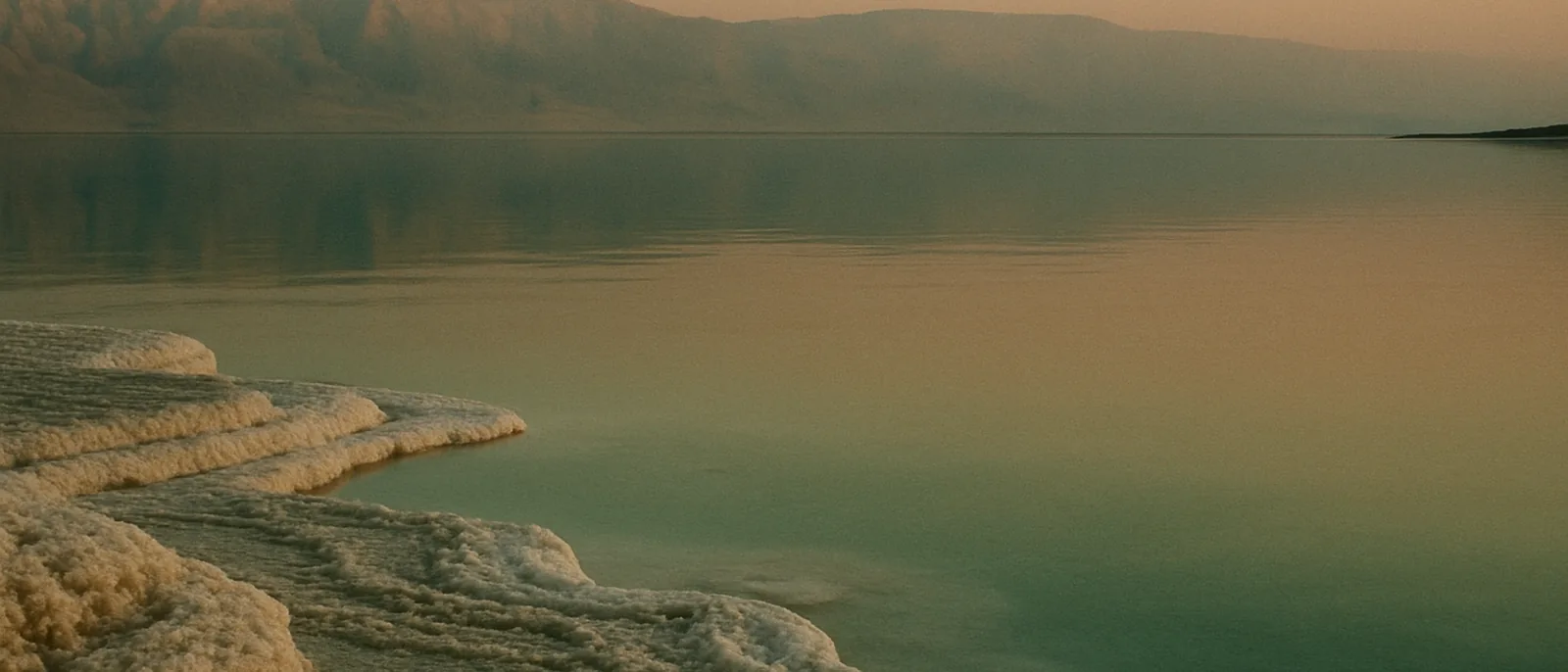
This entry examines the phrase adna al-ard in Surah ar-Rum 30:2–3, describing the land where the Byzantines were defeated, and the argument that it carries a dual sense — the "nearest" land and the "lowest" land — with the second sense verifiable only by modern geodesy at the Dead Sea depression.
The source text
غُلِبَتِ ٱلرُّومُ
“The Byzantines have been defeated”
Qur'an 30:2 · Saheeh International
فِىٓ أَدْنَى ٱلْأَرْضِ وَهُم مِّنۢ بَعْدِ غَلَبِهِمْ سَيَغْلِبُونَ
“In the nearest land. But they, after their defeat, will overcome”
Qur'an 30:3 · Saheeh International
What was understood in the seventh century
The verses refer to the Byzantine defeats by Sasanian Persia in the campaigns of 613–614 CE, when Persian armies overran Syria and Palestine and took Jerusalem in 614. News of these events reached Mecca, where the Prophet Muhammad (peace be upon him) and his followers sympathized with the scriptural Byzantines while the pagan Quraysh favoured the Persians; the passage then foretells a Byzantine recovery, a prophecy treated separately in this catalog's prophecies section. For Meccans the conflict carried religious meaning: the Byzantines were a people of scripture, while Sasanian Persia was Zoroastrian, so the distant war was followed with partisan attention.
Classical exegetes understood adna primarily as "nearest" — the Byzantine land nearest to Arabia — though the Arabic root also carries the sense of "lowest." What no one in the seventh century could do was measure the elevation of land relative to sea level: determining that a valley floor lies below the surface of a distant sea requires levelling instruments and a geodetic reference, and neither existed anywhere in the world at the time.
The modern correspondence
Modern surveying changed that. Nineteenth-century expeditions to the Jordan Valley established by the 1830s–1840s that the Dead Sea lies far below the level of the Mediterranean, with the 1848 Lynch expedition among the landmark surveys. The Dead Sea shore is the lowest exposed land on Earth, today roughly 430 metres below sea level and still dropping as the lake shrinks, as recorded in the Encyclopaedia Britannica entry on the Dead Sea.
Since the fighting of 613–614 swept through Palestine and the Jordan Valley, commentators have argued that adna al-ard may be read in both of its senses at once: the land nearest to Arabia and the lowest land on the planet's surface — the latter a fact confirmable only twelve centuries later. This dual-sense reading gained wide popularity in twentieth-century apologetic literature; the historical setting of the campaigns is summarized in the references below, including Britannica's account of the emperor Heraclius.
Considerations and counterpoints
Critics respond that the primary and classical meaning of adna is "nearest," which fits the context exactly — the closest Byzantine territory to Arabia — and that the elevation reading is a retro-interpretation adopted only after modern geodesy identified the Dead Sea's record depth. They also note that the defeats of 613–614 spanned a wide theatre from Antioch to Egypt, so locating the referenced defeat specifically at the Dead Sea depression is a post-hoc selection among battlefields.
Proponents counter that Arabic genuinely derives "nearest" and "lowest" from the same root, and that the Jordan Valley was in fact a corridor of the Persian advance. The geographic fact is solid and the linguistic ambiguity is real, but because the "lowest" sense is secondary to the plain classical meaning and the exact battlefield is unspecified, the correspondence argued here is graded as suggestive rather than demonstrative.
Credibility rating: Tier 2 · Interpretive — The geographic fact is solid and the Arabic genuinely admits both senses, but the 'lowest' reading is secondary to the plain classical meaning 'nearest' and the exact battlefield is unspecified.