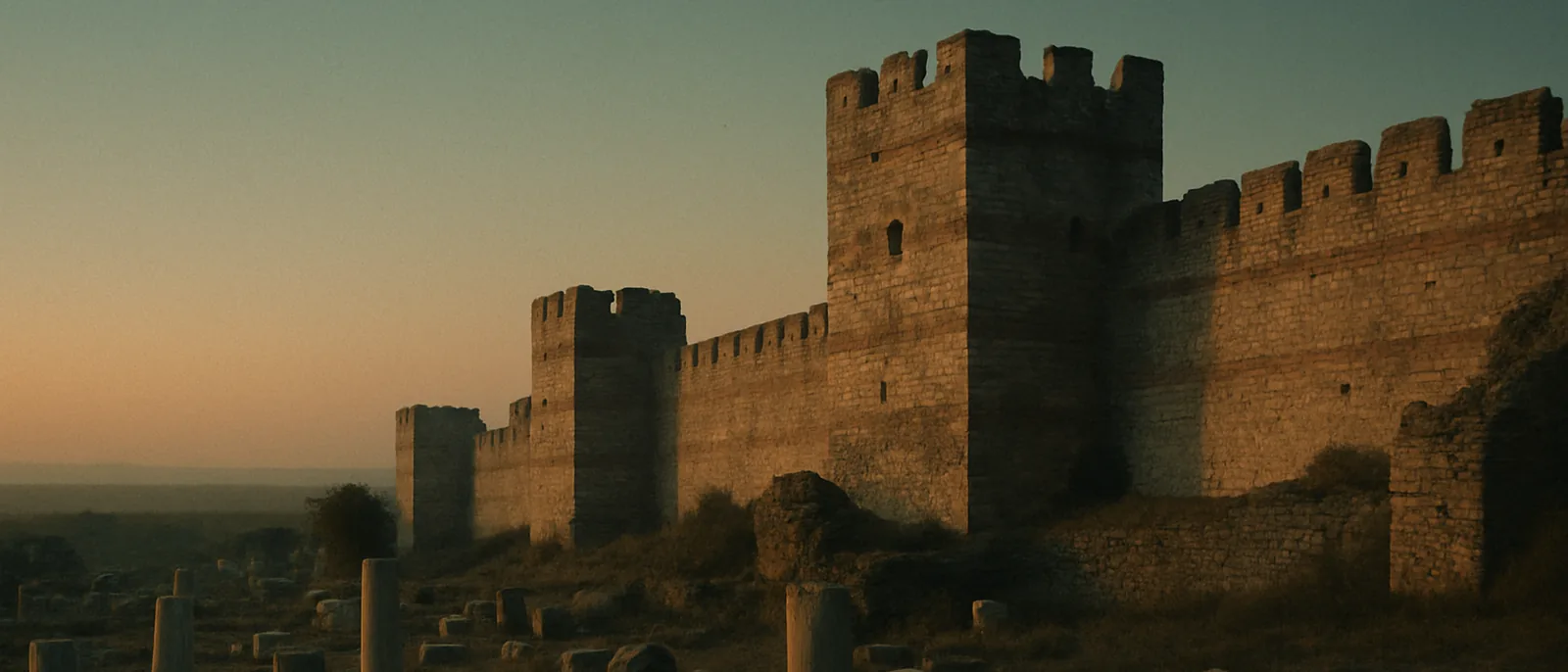
This entry examines the announcement in Surah ar-Rum that the defeated Byzantines would prevail again "within three to nine years," made at the lowest point of Byzantine fortunes. It sets the verses in their seventh-century moment and traces the documented reversal that followed, together with the textual objection critics raise.
The source text
غُلِبَتِ ٱلرُّومُ
“The Byzantines have been defeated”
Qur'an 30:2 · Saheeh International
فِىٓ أَدْنَى ٱلْأَرْضِ وَهُم مِّنۢ بَعْدِ غَلَبِهِمْ سَيَغْلِبُونَ
“In the nearest land. But they, after their defeat, will overcome”
Qur'an 30:3 · Saheeh International
فِى بِضْعِ سِنِينَ ۗ لِلَّهِ ٱلْأَمْرُ مِن قَبْلُ وَمِنۢ بَعْدُ ۚ وَيَوْمَئِذٍ يَفْرَحُ ٱلْمُؤْمِنُونَ
“Within three to nine years. To Allāh belongs the command [i.e., decree] before and after. And that day the believers will rejoice”
Qur'an 30:4 · Saheeh International
What was understood in the seventh century
When these ayat were revealed — traditionally around 615–616 CE — Sasanian Persia under Khosrow II was dismantling the Byzantine Empire piece by piece. Damascus fell in 613, Jerusalem in 614 with the relic of the True Cross carried off to Ctesiphon, and Egypt followed by 619. To contemporary observers, Byzantium could reasonably appear finished as a great power, and no worldly indicator pointed to recovery within a few years.
Early reports preserve the political texture of the moment: the Meccan polytheists sympathized with the fire-worshipping Persians, while the Muslims sympathized with the scriptural Byzantines. The same reports state that Abu Bakr, on the strength of the verses, wagered with a Meccan opponent that the Byzantines would recover — a detail that presupposes the verses were understood from the start as a forward-looking claim with a deadline. The Arabic term bid', used in the verse, denotes a span of roughly three to nine years.
The fulfillment record
The fulfillment record is unusually well dated, because it belongs to mainstream Byzantine and Persian history. The emperor Heraclius launched his counteroffensive in 622 CE, campaigned through the Persian rear from 624, and destroyed the Sasanian field army at Nineveh in December 627. Khosrow II was deposed and killed in February 628, and the True Cross was restored to Jerusalem in 630. What had looked like terminal collapse became one of the most complete strategic reversals of late antiquity, documented in the sources summarized in the references below.
The correspondence argued here is that the reversal fell inside the bid' window on either natural count: from the fall of Jerusalem in 614 to Heraclius's first victories in 622 is eight years, and from the verses' likely revelation to the decisive campaigns of 624–628 is a similar span. Muslim tradition adds a further touch — that news of Byzantine success reached the Muslims around the time of their own victory at Badr in 624, matching the clause "that day the believers will rejoice."
Considerations and counterpoints
The classical discussion itself preserves the strongest objection. A minority, non-canonical variant reading with reversed vowels — "the Romans have conquered... they will be defeated" — is recorded in some tafsir literature, and the earliest Qur'anic script lacked the marks distinguishing the two readings. Critics therefore argue the text could have been vocalized after the fact to fit whichever outcome occurred, and they add that bid' is an elastic window whose start and end dates can be selected post hoc. Defenders respond that the canonical reading is overwhelmingly attested in the recitation tradition, that authorities such as al-Tabari and al-Razi class the reversed reading as anomalous (shadhdh), and that the wager reports presuppose the predictive reading from the beginning. Both positions belong to the record, and readers can weigh them against the dates above.
Credibility rating: Tier 1 · Strong — Canonical text is explicit, the prediction was made when it ran against all appearances, and the fulfillment is precisely documented in Byzantine sources.