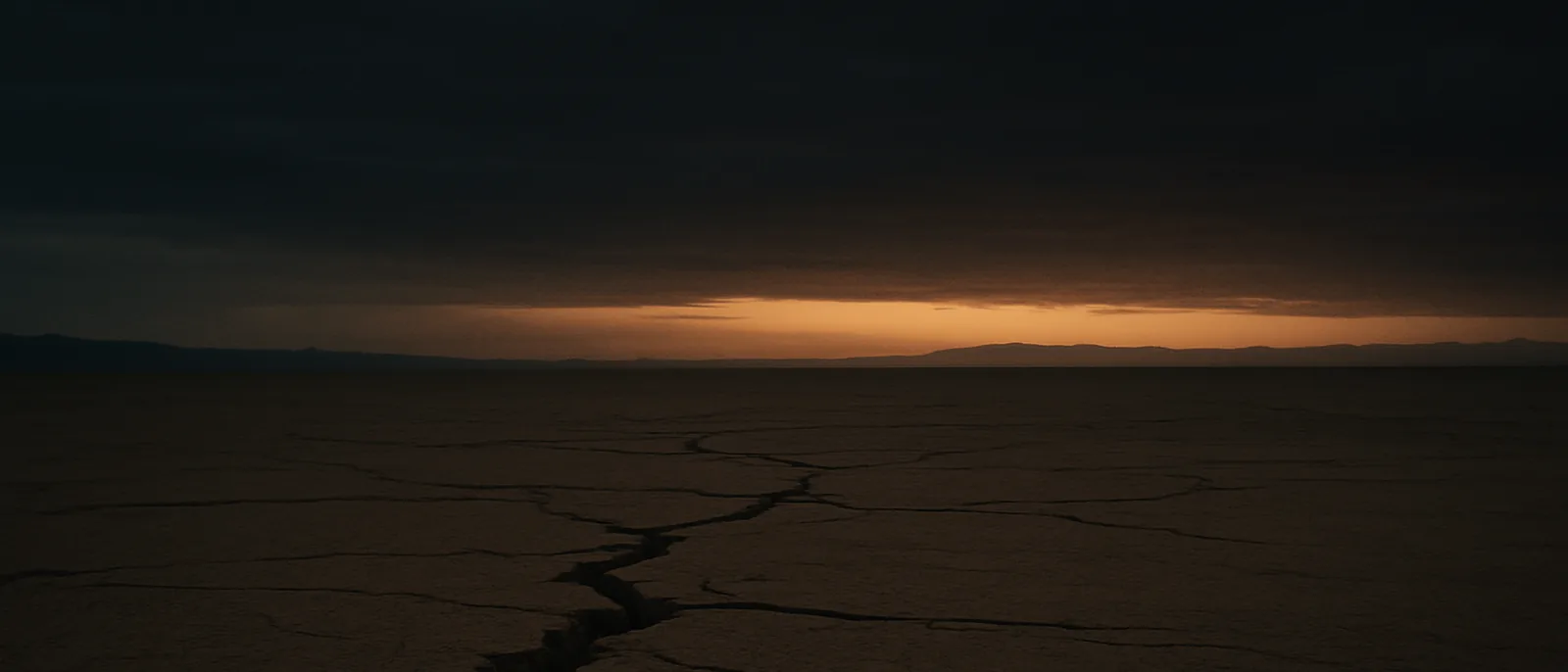
This entry examines Surah az-Zalzalah 99:1–5, the final earthquake in which the earth discharges its burdens and reports its news. The passage is explicitly eschatological, and this catalog records it as such: it makes no scientific knowledge-claim, and it appears here only because popular compilations sometimes list it as a geology item. The framing throughout is deliberately cautious.
The source text
إِذَا زُلْزِلَتِ ٱلْأَرْضُ زِلْزَالَهَا
“When the earth is shaken with its [final] earthquake”
Qur'an 99:1 · Saheeh International
وَأَخْرَجَتِ ٱلْأَرْضُ أَثْقَالَهَا
“And the earth discharges its burdens”
Qur'an 99:2 · Saheeh International
وَقَالَ ٱلْإِنسَـٰنُ مَا لَهَا
“And man says, "What is [wrong] with it?" -”
Qur'an 99:3 · Saheeh International
يَوْمَئِذٍ تُحَدِّثُ أَخْبَارَهَا
“That Day, it will report its news”
Qur'an 99:4 · Saheeh International
بِأَنَّ رَبَّكَ أَوْحَىٰ لَهَا
“Because your Lord has inspired [i.e., commanded] it.”
Qur'an 99:5 · Saheeh International
What was understood in the seventh century
Earthquakes were known and feared in seventh-century Arabia and the surrounding lands; the Hijaz sits near the seismically active Red Sea rift and the volcanic fields of western Arabia. The surah describes a singular, final convulsion in which the earth casts out its "burdens" (athqal) and testifies to human deeds. Classical exegesis unanimously placed this scene on the Day of Resurrection, understanding the burdens as the dead and the buried treasures cast out of the ground. The audience's familiarity with earthquakes mattered rhetorically: the surah uses a shared and feared experience to picture something categorically greater — a shaking of the whole earth at once, unlike any regional tremor.
The modern correspondence
Some modern popularizers have nonetheless linked the surah's imagery to seismology, noting that great earthquakes can eject subsurface material through liquefaction and sand blows, that the earth's interior holds dense metallic loads, or reading verse 99:4's "report its news" as an anticipation of the geological record. Mainstream earthquake science, as summarized by the U.S. Geological Survey, explains earthquakes as sudden slip on faults releasing accumulated elastic strain — a framework with no inherent connection to a single terminal event. Liquefaction and sand blows are indeed documented features of large earthquakes, but they are local effects of particular events, not signatures of a final, universal convulsion. The correspondence argued in popular literature is therefore homiletic rather than evidential.
Considerations and counterpoints
There is little here for a skeptic to rebut, because the honest reading is theological: a description of the Last Day, not of seismology. Critics of the apologetic genre cite this passage as an example of over-reach when it is presented as a scientific sign, since earthquakes were universally known in antiquity and the surah's content is moral and eschatological. This site accordingly presents the passage as eschatology carried in powerful seismic imagery, and readers should treat any scientific framing of it as unsupported by the text. Presenting the surah this way is arguably also more faithful to its own emphasis, which falls on accountability for human deeds rather than on the mechanics of the ground.
Credibility rating: Tier 3 · Contested — The passage is explicitly eschatological and offers no scientific claim; it is included for completeness because popular literature sometimes lists it as a geology item.