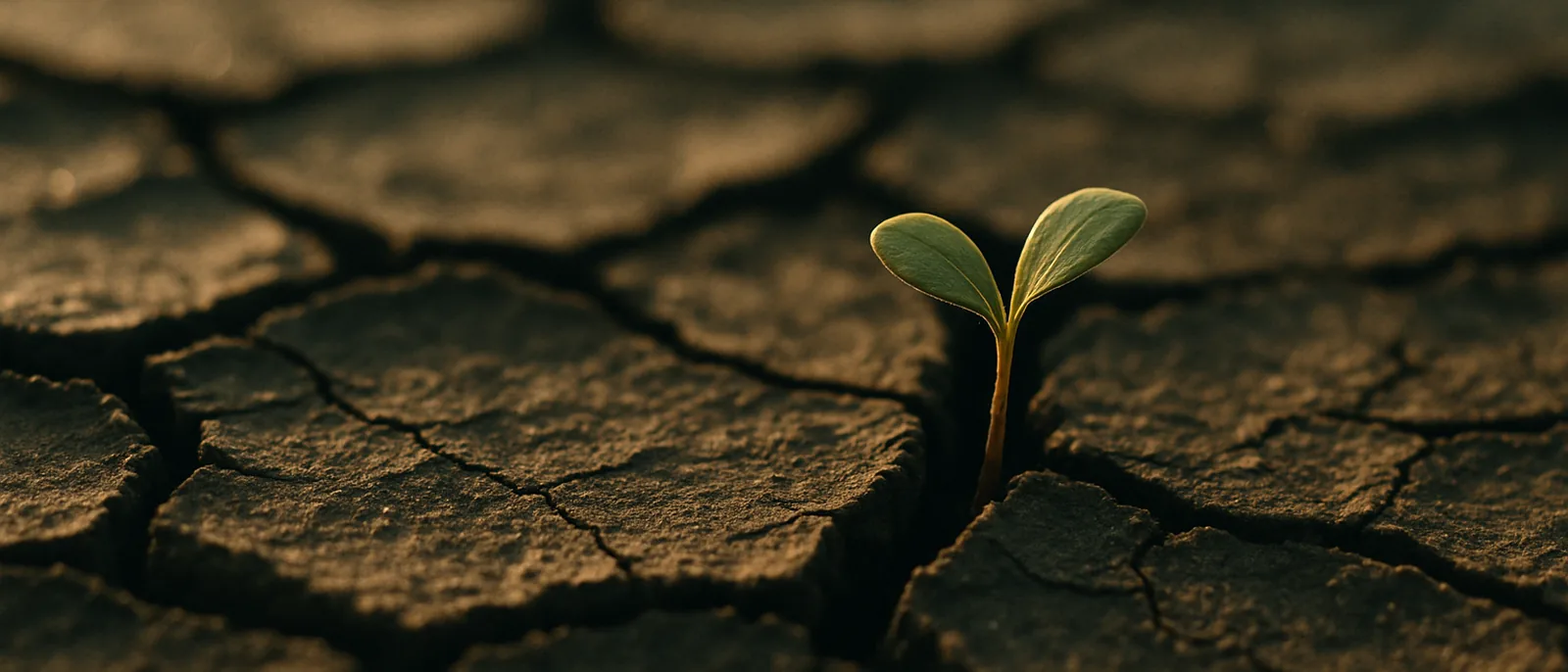
This entry examines the oath "by the earth which splits" in Surah at-Tariq 86:12 and the agricultural sequence of Surah 'Abasa 80:25–28, alongside the modern extension of the first passage to the Earth's global fault systems. The extended reading is presented here as weak; the plain agricultural sense was available to any seventh-century observer.
The source text
وَٱلْأَرْضِ ذَاتِ ٱلصَّدْعِ
“And [by] the earth which splits,”
Qur'an 86:12 · Saheeh International
أَنَّا صَبَبْنَا ٱلْمَآءَ صَبًّا
“How We poured down water in torrents,”
Qur'an 80:25 · Saheeh International
ثُمَّ شَقَقْنَا ٱلْأَرْضَ شَقًّا
“Then We broke open the earth, splitting [it with sprouts],”
Qur'an 80:26 · Saheeh International
فَأَنۢبَتْنَا فِيهَا حَبًّا
“And caused to grow within it grain”
Qur'an 80:27 · Saheeh International
وَعِنَبًا وَقَضْبًا
“And grapes and herbage”
Qur'an 80:28 · Saheeh International
What was understood in the seventh century
Surah at-Tariq swears an oath by "the earth possessing sad'" — a word for splitting or cracking — paired with an oath by the returning sky, while Surah 'Abasa describes water poured down and the earth split open for grain, grapes and fodder. Arab farmers and pastoralists knew these sights intimately: soil cracking after rain, and seedlings breaking through the ground. The classical exegetes read the oath in exactly this agricultural sense, glossing sad' as the earth splitting for plants. The two passages work in different registers — a cosmic oath in the first case, a lesson on divine provision in the second — but both turn on the same everyday image of ground breaking open.
The modern correspondence
Some modern commentators have extended the oath of 86:12 to the network of faults, rifts and joints that fracture the Earth's crust — features mapped systematically by structural geology since the nineteenth century and central to plate tectonics, from mid-ocean rifts to the transform faults catalogued by the U.S. Geological Survey. On this reading, the "earth of cracks" becomes a reference to the planet's global fracture systems rather than to soil breaking for plants.
The agricultural passage in 80:25–28, for its part, accurately sequences rain, soil rupture and germination — a process whose physiology, including imbibition and the pressure exerted by the emerging radicle in splitting the soil, was described by modern plant science. This is an accurate ordering of a familiar process rather than a disclosure of hidden information.
Considerations and counterpoints
Skeptics note that cracked earth and sprouting seeds were among the most visible phenomena of ancient agricultural life, so the verses describe nothing unavailable to their first audience, and classical tafsir itself reads them that way. Reading crustal fault systems into a one-word oath is, critics argue, a projection: the text contains no detail of depth, extent or mechanism that would distinguish a geological fault from a furrow. Even within the apologetic genre this item's scientific framing is generally regarded as weak, and it is presented here accordingly, with the agricultural sense primary. The entry is retained because the fault-system reading circulates widely, but the case depends entirely on how far a single word may be stretched beyond its plain classical sense.
Credibility rating: Tier 3 · Contested — The plain sense — soil splitting for vegetation — was ordinary seventh-century observation, and the global-fault reading is a modern extension the text does not require.