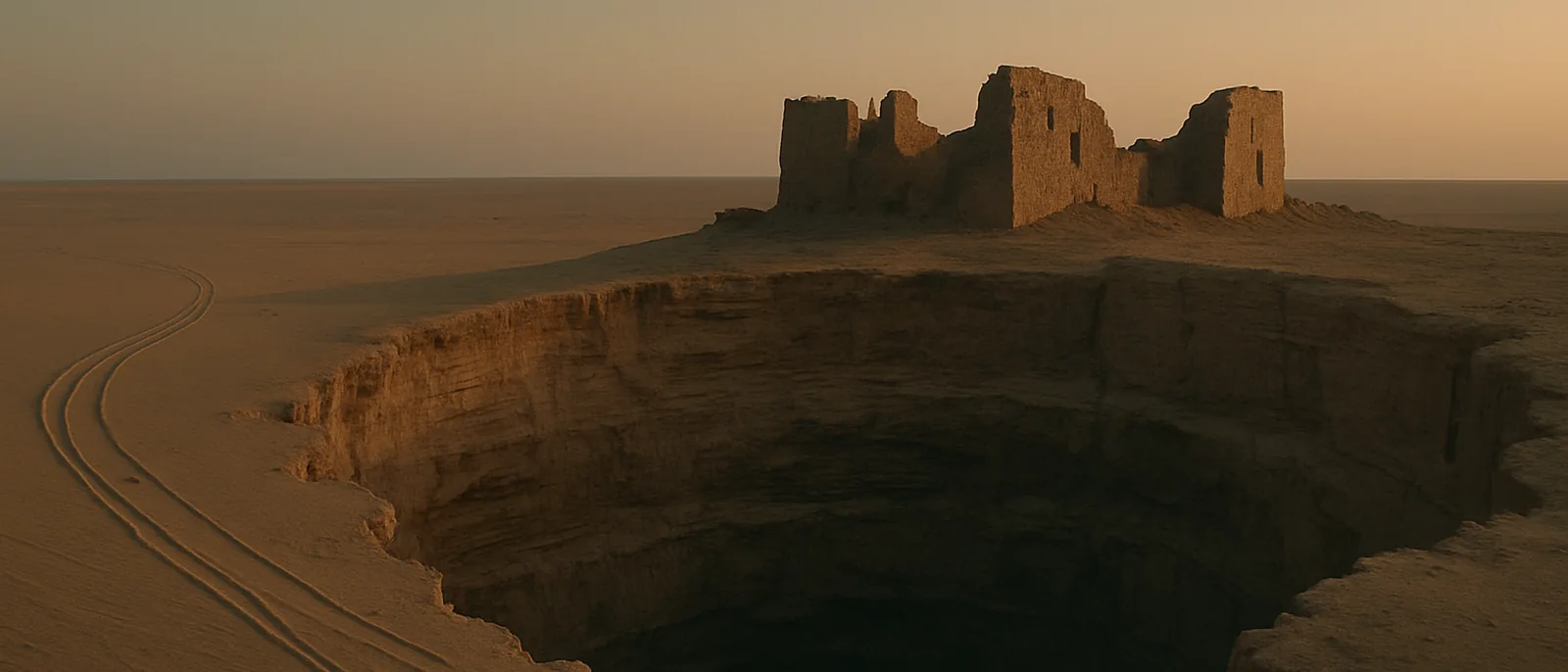
This entry examines the mention of Iram 'of the pillars,' associated with the vanished people of 'Aad, in Surah al-Fajr, together with two modern claims often attached to it: a supposed appearance of the name in the Ebla tablets, and the 1992 radar-guided excavation at Shisr in Oman. Both supporting claims are contested in the specialist literature, and the case here rests on disputed identifications.
The source text
إِرَمَ ذَاتِ ٱلْعِمَادِ
“[With] Iram - who had lofty pillars,”
Qur'an 89:7 · Saheeh International
أَلَمْ تَرَ كَيْفَ فَعَلَ رَبُّكَ بِعَادٍ
“Have you not considered how your Lord dealt with 'Aad -”
Qur'an 89:6 · Saheeh International
ٱلَّتِى لَمْ يُخْلَقْ مِثْلُهَا فِى ٱلْبِلَـٰدِ
“The likes of whom had never been created in the land?”
Qur'an 89:8 · Saheeh International
What was understood in the seventh century
The people of 'Aad were already part of pre-Islamic Arabian lore; early Arabic poetry and proverbs used 'Aad as a byword for a vanished ancient nation. In naming them, the Qur'an was invoking a tradition its audience recognized, not revealing an unknown name.
'Iram of the pillars, the like of which was never created in the lands' was, however, unlocatable — in the seventh century and for long afterward. Later skeptics treated Iram as pure legend, a lost city of story rather than geography.
The modern correspondence
The first modern claim holds that the name 'Iram' appears in the Ebla tablets, excavated in Syria from 1974 and dating to roughly 2300 BCE. This rests on a 1978 National Geographic popularization of early readings of the archive; Ebla specialists subsequently retracted or disputed most of the sensational name identifications from that period, so the claim cannot be considered established.
The second claim followed a 1992 expedition that used NASA/JPL space-borne radar imaging to trace old caravan tracks converging on Shisr in Oman's Dhofar region, where excavation revealed a collapsed fortified settlement — publicized worldwide as 'Ubar,' the 'Atlantis of the Sands,' and sometimes identified with Iram (the JPL accounts are in the references below). The excavators themselves, including archaeologist Juris Zarins, later cautioned that 'Ubar' in the sources is better understood as a region or tribal territory than as a single lost city. What the finds do establish is that a substantial outpost of the frankincense trade stood at the desert's edge and was destroyed when the limestone cavern beneath it collapsed; its identification with the Qur'anic Iram remains speculative.
Considerations and counterpoints
Skeptics note that 'Aad and Iram required no special knowledge — they were stock figures of Arabian legend before Islam — and that the Qur'an gives no locatable detail that archaeology has since confirmed. The Ebla reading belonged to a wave of premature identifications later abandoned by the epigraphers themselves, and Shisr is a modest waystation, difficult to square with 'the like of which was never created in the lands.' On this reading the verses recall folklore, and the modern discoveries have been retrofitted to them. The Tier 3 grading reflects that both pillars of the modern case are disputed or withdrawn.
Credibility rating: Tier 3 · Contested — Both supporting claims (Ebla mention, Ubar identification) are contested or retracted in the specialist literature, and 'Aad was already known in pre-Islamic Arabia.