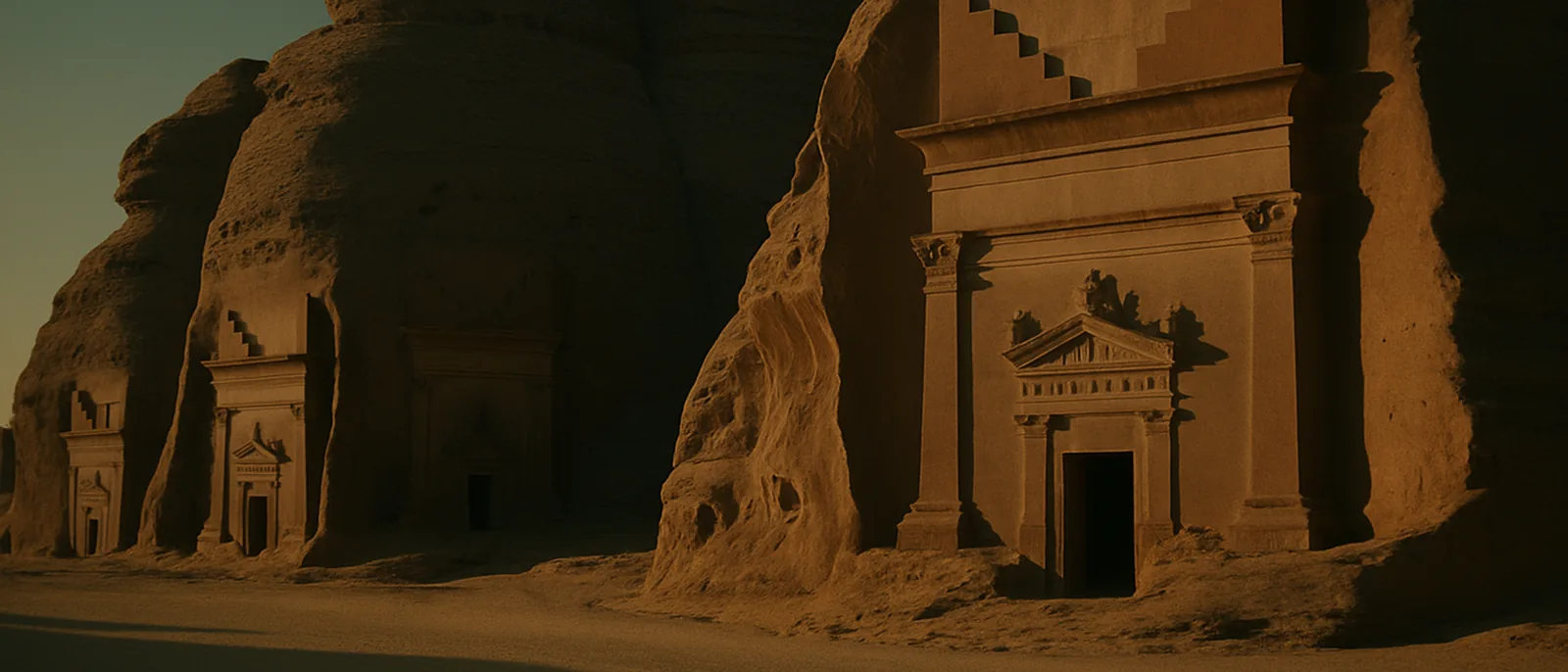
This entry considers the Qur'an's account of the people of Thamud carving elaborate homes into the mountains, and the rock-cut monuments that survive in the region the Qur'an names for them. It is a historical and archaeological correspondence rather than a scientific one, and it comes with an honest chronological caveat.
The source text
وَٱذْكُرُوٓا۟ إِذْ جَعَلَكُمْ خُلَفَآءَ مِنۢ بَعْدِ عَادٍ وَبَوَّأَكُمْ فِى ٱلْأَرْضِ تَتَّخِذُونَ مِن سُهُولِهَا قُصُورًا وَتَنْحِتُونَ ٱلْجِبَالَ بُيُوتًا
“And remember when He made you successors after the 'Aad and settled you in the land, [and] you take for yourselves palaces from its plains and carve from the mountains, homes.”
Qur'an 7:74 · Saheeh International
وَكَانُوا۟ يَنْحِتُونَ مِنَ ٱلْجِبَالِ بُيُوتًا ءَامِنِينَ
“And they used to carve from the mountains, houses, feeling secure.”
Qur'an 15:82 · Saheeh International
وَتَنْحِتُونَ مِنَ ٱلْجِبَالِ بُيُوتًا فَـٰرِهِينَ
“And you carve out of the mountains, homes, with skill.”
Qur'an 26:149 · Saheeh International
What was understood in the seventh century
The Qur'an tells of Thamud, an ancient Arabian people to whom the prophet Salih (peace be upon him) was sent, and it names their dwelling place as al-Hijr. Across several passages it describes them, distinctively, as carving houses directly out of the mountains: taking 'palaces from its plains' and hewing 'from the mountains, homes,' and doing so 'with skill' while 'feeling secure.' The rock-cutting is presented as a mark of their strength and craft, and the narrative warns that their fortified stone dwellings did not spare them when judgment came.
This is a specific and unusual detail. The text does not merely place a people in the desert; it ties them to a particular and demanding building method — cutting architecture into living rock — and fixes them at a named location in Arabia.
The modern correspondence
Northwest Arabia contains exactly this kind of architecture. The site the Qur'an calls al-Hijr is known today as Hegra, or Mada'in Salih, near al-'Ula in Saudi Arabia. There, scores of monumental tombs and chambers are carved directly into isolated sandstone outcrops, their facades worked in fine detail. In 2008 Hegra became Saudi Arabia's first UNESCO World Heritage Site.
The correspondence argued here is one of place and practice: the Qur'an locates a mountain-carving people precisely in the region that preserves the most striking rock-cut monuments of ancient Arabia, and describes their signature technique accurately. A reader in seventh-century Arabia relaying a generic tale of a lost people need not have tied them so consistently to this specific method and this specific place.
Considerations and counterpoints
The correspondence is real but must not be overstated, which is why the entry is graded Tier 3. The best-known monuments at Hegra — the ornate carved tomb facades — are Nabataean, produced roughly between the first century BCE and the first century CE, well after the period traditionally assigned to Thamud. They are therefore not, strictly, the dwellings of the people the Qur'an describes; the match is with the site and the rock-carving tradition of the region, not a dated identification of Thamud's own houses.
Sceptics add that carving dwellings into rock was practiced widely across the ancient Near East — at Petra, and in the rock tombs of Egypt and Anatolia — so the motif is not unique, and that the ruins of al-Hijr were locally visible and famous, so a text originating in Arabia naming them is unremarkable. Defenders respond that the Qur'an's consistency is still notable: it repeatedly attaches this particular building method to Thamud and fixes them at al-Hijr, the one place in Arabia most associated with monumental rock-cut architecture. Read modestly, the entry documents an accurate geographical and cultural correspondence, not a precise archaeological dating.
Credibility rating: Tier 3 · Contested — The Qur'an's placement of a rock-carving people at al-Hijr matches the real rock-cut architecture of the region, but the surviving monumental tombs at Hegra are Nabataean and later than the Qur'anic Thamud, so the correspondence is with the site and tradition rather than a dated match.