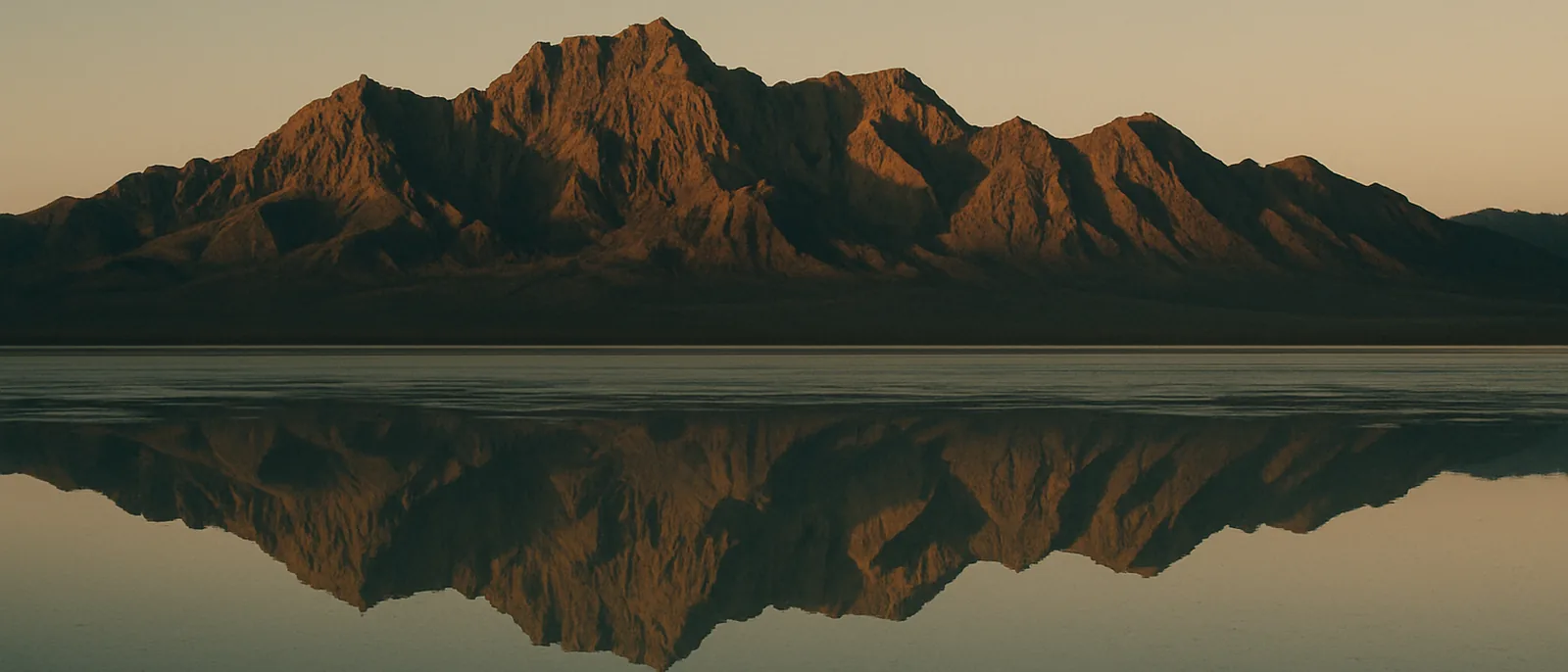
This entry examines the Qur'anic description of mountains as stakes (awtad) and firmly set anchors (rawasi), set beside the modern geological account of mountain roots and isostasy. The question weighed here is whether the pairing of a driven-stake image with a stabilizing function corresponds to anything that could not have been observed in the seventh century.
The source text
أَلَمْ نَجْعَلِ ٱلْأَرْضَ مِهَـٰدًا
“Have We not made the earth a resting place?”
Qur'an 78:6 · Saheeh International
وَٱلْجِبَالَ أَوْتَادًا
“And the mountains as stakes?”
Qur'an 78:7 · Saheeh International
وَأَلْقَىٰ فِى ٱلْأَرْضِ رَوَٰسِىَ أَن تَمِيدَ بِكُمْ وَأَنْهَـٰرًا وَسُبُلًا لَّعَلَّكُمْ تَهْتَدُونَ
“And He has cast into the earth firmly set mountains, lest it shift with you, and [made] rivers and roads, that you may be guided,”
Qur'an 16:15 · Saheeh International
وَجَعَلْنَا فِى ٱلْأَرْضِ رَوَٰسِىَ أَن تَمِيدَ بِهِمْ وَجَعَلْنَا فِيهَا فِجَاجًا سُبُلًا لَّعَلَّهُمْ يَهْتَدُونَ
“And We placed within the earth firmly set mountains, lest it should shift with them, and We made therein [mountain] passes [as] roads that they might be guided.”
Qur'an 21:31 · Saheeh International
خَلَقَ ٱلسَّمَـٰوَٰتِ بِغَيْرِ عَمَدٍ تَرَوْنَهَا ۖ وَأَلْقَىٰ فِى ٱلْأَرْضِ رَوَٰسِىَ أَن تَمِيدَ بِكُمْ وَبَثَّ فِيهَا مِن كُلِّ دَآبَّةٍ ۚ وَأَنزَلْنَا مِنَ ٱلسَّمَآءِ مَآءً فَأَنۢبَتْنَا فِيهَا مِن كُلِّ زَوْجٍ كَرِيمٍ
“He created the heavens without pillars that you see and has cast into the earth firmly set mountains, lest it should shift with you, and dispersed therein from every creature. And We sent down rain from the sky and made grow therein [plants] of every noble kind.”
Qur'an 31:10 · Saheeh International
What was understood in the seventh century
For the tent-dwelling Arabs of seventh-century Arabia, the stake (watad) was among the most familiar of objects: a peg whose buried portion, driven deep into the ground, holds a visible structure steady against the wind. Applied to mountains, the image spoke naturally to a people for whom mountains were the most permanent features of the landscape. Several verses extend the image with a function, describing firmly set mountains cast into the earth "lest it shift with you."
What no pre-modern culture possessed was any reason to think that a mountain continues downward beneath the surface. To ancient observers everywhere, a mountain was simply a mass piled on top of the earth. It should also be noted that comparable stabilizing imagery existed in older Near Eastern literature, which spoke of the earth resting on pillars or foundations; that background belongs to any fair reading of these verses.
The modern correspondence
The modern picture emerged in stages. Anomalies in George Everest's survey of India in the 1840s suggested that the visible mass of the Himalayas did not account for their gravitational effects; the rival hypotheses of Pratt and Airy in 1855 proposed that surface topography is compensated by structures at depth, and Clarence Dutton coined the term "isostasy" for this balance in 1889. Twentieth-century seismology then confirmed that continental crust thickens to roughly 60–70 kilometres beneath major ranges, against about 35 kilometres elsewhere: mountain ranges possess deep crustal "roots" extending into the denser mantle, broadly as an iceberg rides with most of its bulk submerged (see the Encyclopaedia Britannica entry on isostasy).
Commentators have noted that a stake is precisely an object whose larger portion lies below the surface, and that the Qur'anic pairing of surface mountains with a stabilizing role loosely parallels the part played by isostatic roots and thick lithosphere in supporting and steadying continental blocks, within the framework of plate motion summarized by the U.S. Geological Survey. Geologists such as Frank Press, whose textbook Earth describes mountains as having root structures, are frequently quoted in this connection by Muslim apologists.
Considerations and counterpoints
Critics point out that mountains are products of the same plate-tectonic forces that generate earthquakes, and that seismicity in fact concentrates in young mountain belts; geologists do not describe mountains as devices that stop the earth from shaking. On this view, the verses' stabilizing function is an interpretive reading that mainstream geology does not state in those terms.
Critics add that peg-and-pillar imagery for the earth was commonplace in ancient Near Eastern cosmology, so the metaphor itself required no special knowledge, and that mapping isostatic roots onto the single word awtad is a retrospective projection of modern science onto a poetic image. Defenders respond that some geophysical literature does credit thick lithospheric roots with damping deformation of continental interiors, but the correspondence argued here remains interpretation-dependent, which is why this entry carries a middle grading rather than a strong one.
Credibility rating: Tier 2 · Interpretive — The texts are authentic and the root/peg analogy with isostasy is real, but the claimed stabilizing function is an interpretive reading that mainstream geology does not state in those terms.